Buyer intent keywords are the search queries where the person typing is actively evaluating, comparing, or preparing to buy. Most B2B SaaS teams already rank for some of them. The problem is that keyword tools measure volume. They do not tell you whether the person searching is ready to buy. The queries that fill your pipeline rarely look like the queries that fill your traffic reports.
Consider the difference: "what is property management software" pulls thousands of monthly searches and brings in early-stage learners. "Best property management software for small landlords" pulls a fraction of that volume and brings in buyers with a shortlist. If your keyword strategy starts and ends with a volume column in a spreadsheet, you are optimizing for the first query and leaving the second one to your competitors.
This is a signal problem. Buyer intent keywords for B2B SaaS include queries like "best [category] software for [use case]," "[product] vs [competitor]," and "[category] pricing," where the searcher is actively evaluating solutions. This post walks through how to find them using first-party buyer research, how to score their intent systematically, and how to build content that earns visibility in both Google and AI search engines. Buyer signals are the input layer of a wider SaaS content strategy; this post zooms in on the keyword side of that input.
What makes a keyword a buyer intent keyword
A buyer intent keyword is any search query where the searcher's primary goal is to evaluate, compare, or purchase a product or service. The defining characteristic is action orientation: the person has moved past learning about a topic and is now assessing specific solutions. In B2B SaaS, this includes comparison queries, pricing queries, alternative-to queries, and use-case-specific feature queries.
Search intent falls into four broad categories: informational, navigational, commercial, and transactional. Buyer intent spans commercial and transactional. Commercial intent queries ("best construction estimating software for general contractors") signal active evaluation. Transactional queries ("Procore pricing" or "request demo for Buildium") signal readiness to act.
The modifier patterns for B2B buyer intent keywords differ significantly from B2C. B2B buyer intent modifiers include "vs," "alternative to," "for [use case]," "pricing," and "demo." B2C buyer intent keywords typically use "buy," "discount," "coupon," and "near me." If your keyword research relies on generic modifier lists built for e-commerce, you are missing the queries that matter for SaaS pipeline.
Volume is misleading at the intent level. A 50-volume "vs" query comparing two lending platforms can drive more qualified demos than a 5,000-volume "what is" query about lending software. B2B SaaS demo-led funnels convert visitors to demo requests at 1-3%, and trial-led funnels convert at 3-7% (Zeliq, 2025-2026). When your conversion rates are that narrow, the difference between a buyer and a browser in your traffic matters enormously.
The practical distinction: high intent keywords are the ones where you can trace a line from the query to a pipeline event. Everything else is supporting content.
Where buyer intent keywords actually come from
The highest-converting buyer intent keywords come from places most SEO teams never look: G2 and Capterra reviews, Reddit threads, sales call transcripts, and support tickets. Keyword tools are useful for validating volume after you have identified the language. They should be step two.
First-party buyer signals
70% of the B2B buying journey happens anonymously (6sense, 2025). Buyers research extensively before they ever contact a vendor. That research happens in specific, observable places.
G2 and Capterra reviews reveal the exact phrases buyers use when evaluating solutions. Read the comparison sections: what alternatives do reviewers mention? What use cases do they describe? What language do they use to describe the problem your software solves? A FinTech buyer writing "we needed a payment reconciliation tool that integrates with QuickBooks" is handing you a buyer intent keyword on a platter. There is a repeatable framework for turning G2 review data into buyer-language signals if you want to run this systematically.
Reddit is where buyers ask for recommendations with zero brand filter. Subreddits like r/proptech, r/fintech, and r/construction are full of threads where someone asks "what's the best [category] for [specific use case]?" The language in those threads is raw buyer language, often technical, specific, and completely absent from keyword databases. The full playbook for earning AI citations from Reddit specifically lives in our Reddit AEO post.
Sales call transcripts contain the questions prospects ask before signing. "How does your pricing compare to [competitor]?" and "does this work for [specific vertical]?" are both buyer intent keywords hiding in your CRM. As Konstruct Digital's B2B keyword research guide puts it, effective keyword research surfaces language that often has "nothing to do with your product category" as it appears in keyword tools.
This is the core of ICP-driven keyword research: starting from what real buyers actually ask, in their own language, at the moment they are evaluating solutions.
Keyword tools as validation
Once you have a list of buyer language from first-party sources, keyword tools become valuable for a different reason. Use Ahrefs, Semrush, or Google Keyword Planner to check volume, keyword difficulty, and SERP landscape for the terms you have identified.
Here is where it gets interesting: when buyer language from G2 or Reddit does not appear in keyword tools, that is often your biggest opportunity. Low volume and zero competition on a query that your sales team hears every week means you can rank quickly and convert the exact people who are ready to buy.
Cross-reference your first-party keyword list against keyword tool data. Keep buyer language terms even when volume looks low. Add volume-validated terms that match the same intent patterns. Drop high-volume terms that fail the buyer intent test.
How to score buyer intent (a practical framework)
Score buyer intent on four dimensions: modifier strength (does the query contain explicit purchase signals?), SERP composition (do paid ads and product pages dominate the results?), conversion history (does this query drive demos or trials in your analytics?), and funnel position (is the searcher evaluating solutions or just learning?). Weight conversion history highest when data is available.
The four-factor framework
- Modifier strength. Rank query modifiers by purchase proximity. Transactional modifiers ("pricing," "demo," "free trial") score highest. Commercial modifiers ("vs," "alternative to," "best [category] for [use case]") score high. Informational modifiers ("what is," "how to," "guide") score low for buyer intent.
- SERP composition. Search the keyword in Google and examine the results. If the first page shows paid ads, product pages, comparison listicles, and G2/Capterra results, the keyword has demonstrated commercial value. If the results are dominated by blog posts and Wikipedia entries, the intent is informational.
- Conversion history. Open GA4 or your CRM and check: which keywords currently drive demo requests, trial signups, or pipeline events? This is the most reliable signal because it uses your own data. A keyword you assumed was informational might already be converting. A keyword you assumed was high-intent might drive traffic that never converts.
- Funnel position. Map the query to a buyer awareness stage. Problem-aware queries ("how to reduce tenant turnover") are early. Solution-aware queries ("property management software features") are mid-funnel. Product-aware queries ("Buildium vs AppFolio") are late-funnel and carry the highest buyer intent.
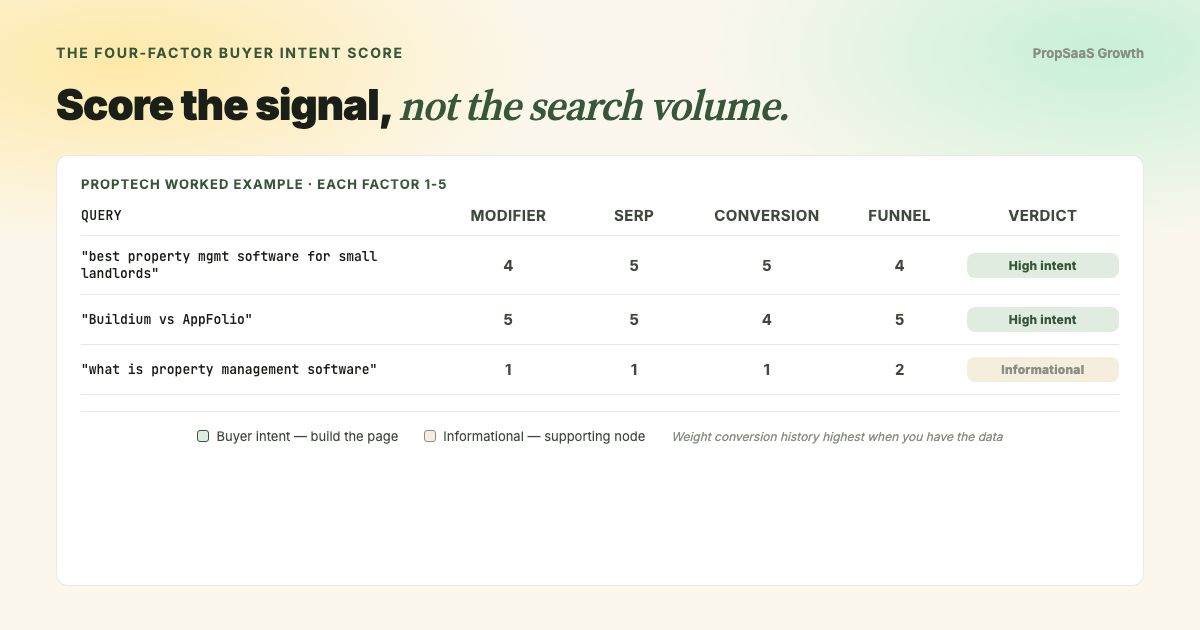
Combine these into a simple score. A query like "best property management software for small landlords" scores high on modifier strength (commercial modifier), high on SERP composition (ads, product pages, and comparison content dominate), and maps to solution-aware funnel position. If your GA4 data shows this query driving demo requests, that is a confirmed high-intent buyer keyword.
Compare that to "what is property management software," which scores low on modifier strength, shows informational SERP results, and maps to problem-aware position. Still worth creating content for (it builds topical authority), but it should not be weighted equally in your content calendar, and it belongs on its own page rather than on the one built to convert.
This scoring approach maps to building a comprehensive query universe that organizes every keyword by both topic cluster and intent tier.
Buyer intent keywords and AI search
AI search engines like ChatGPT, Perplexity, and Google AI Overview handle buyer intent queries differently from Google's traditional results. When a buyer asks "best property management software for small landlords," the AI does not return a list of ten blue links. It decomposes that query into 5-15 sub-questions: feature comparisons, pricing tiers, integration requirements, user reviews, and alternatives. A page that answers one sub-question gets cited once. A page that covers the cluster earns consistent citations.
This matters for two reasons. First, 94% of B2B buyers used a generative AI tool during their most recent purchase process (6sense, 2025). Your buyers are already asking AI engines the same buyer intent queries they used to type into Google. Second, McKinsey projects $750 billion in consumer spend will flow through AI-powered search by 2028, with 20-50% of traditional search traffic at risk as AI captures decisions earlier in the journey (McKinsey, Oct 2025). The channel shift is happening.
The implication for buyer intent keyword strategy is structural. A "one page per keyword" approach fails in AI search because AI engines reward comprehensive coverage of a buyer's full evaluation process. If you have a single page about "best construction estimating software" and nothing about pricing, integrations, or vertical-specific use cases, the AI will cite your page for one sub-question and pull the rest from competitors.
The AEO (Answer Engine Optimization) approach to buyer intent keywords requires structuring content with clear, self-contained answers to each sub-question within the buyer's evaluation process. Lead each section with a direct answer. Include entity-rich context (product names, feature categories, comparison criteria). Build supporting pages that address the sub-questions your pillar page cannot cover in depth.
For a deeper look at how to structure content for AI citations, see how to rank in ChatGPT and building an AI prompt set for B2B SaaS.
Building content around buyer intent keywords
Structure buyer intent content as a cluster: one pillar page covering the core buyer question, supported by comparison pages, alternative-to pages, and use-case-specific guides. Each piece in the cluster should answer a distinct sub-question from the buyer's evaluation process. This approach works for both Google ranking and AI citation coverage.
The buyer intent cluster model
A buyer intent content cluster for a B2B SaaS category follows a consistent architecture:
- Pillar page: A comprehensive buyer guide for the category (e.g., "Best Property Management Software for Small Landlords: 2026 Buyer's Guide").
- Comparison pages: "[Product] vs [Competitor]" posts covering the head-to-head evaluations buyers are already running. These are some of the highest-converting pages in B2B SaaS content. See our guide on comparison pages for B2B SaaS and AEO.
- Vertical-specific guides: "Best [category] for [use case/vertical]" pages that address the specific needs of your ICP segments.
- Pricing guides: "[Category] pricing guide" pages that address one of the most common buyer intent queries in B2B.
This hub-and-spoke model creates internal linking structures that pass authority from supporting pages to your pillar, while giving AI engines multiple citation targets across the buyer's evaluation journey.
The results of this kind of cluster-based approach are measurable. Azibo, a PropTech financial platform, rebuilt its content engine around buyer-intent keyword clusters and grew from 4,000 to 122,000 monthly organic visits, with #1-ranked keywords expanding from 34 to 1,686.
For the full breakdown of how cluster architecture and content-led SEO drove that growth, see the Azibo case study.
Finding keywords your competitors miss
Apply the four-factor intent scoring framework to your competitive analysis:
- Look for queries where competitors rank with informational content but the intent is commercial. If a competitor ranks for "construction estimating software features" with a glossary-style post, and the SERP shows ads and product pages, that is a buyer intent keyword they are underserving.
- Mine People Also Ask boxes and related searches for buyer-stage questions your competitors have not addressed. These are often long-tail queries with strong commercial intent and low competition.
- Check AI answers. Search your core buyer intent prompts in ChatGPT, Perplexity, and Google AI Overview. If no one is cited for a specific buyer question, that is your opening. You can measure AI visibility to track which prompts you are winning and where gaps remain.
The core principle: signals over volume
Every method in this post reduces to one principle: buyer intent keywords are a signal quality problem, and signal quality comes from proximity to the buyer.
Keyword tools sit furthest from the buyer. They aggregate search behavior across millions of people, most of whom will never buy your product. The signal is real but diluted. G2 reviews, Reddit threads, and sales calls sit closest to the buyer. The signal is concentrated because the people producing it are actively evaluating solutions. The language they use is specific, technical, and often invisible to keyword databases.
The four-factor scoring framework bridges these two signal sources. It takes buyer language from first-party research, validates it against keyword tool data, checks it against SERP composition and conversion history, and produces a prioritized list where every keyword has a documented connection to pipeline.
The keywords that matter most are the ones where you can trace a line from the query to a signed contract. Everything else supports those pages.
When you extend this to AI search, the same proximity principle applies. AI engines cite pages that answer buyer sub-questions directly and specifically. Generic coverage gets consulted. Specific, entity-rich, self-contained answers get cited. The pages closest to answering the buyer's actual evaluation criteria win the citation. This is also why traffic and pipeline have come apart for so many B2B SaaS teams: volume-led keyword strategies optimize for the wrong signal.
Action steps
Here is a concrete checklist to run this week:
- Pull 20-30 buyer phrases from G2 and Reddit. Search your category on G2. Read the "Alternatives Considered" and "Reasons for Switching" sections in competitor reviews. Search your category on Reddit and capture the exact language buyers use when asking for recommendations.
- Cross-reference against keyword tools. Take your buyer phrase list into Ahrefs, Semrush, or Google Keyword Planner. Check volume and difficulty. Flag buyer phrases with zero or low keyword volume: these are your lowest-competition, highest-conversion opportunities.
- Score your existing keyword list. Apply the four-factor framework (modifier strength, SERP composition, conversion history, funnel position) to your current target keywords. Identify which ones are genuinely buyer intent and which are informational keywords you have been treating as buyer keywords.
- Check your conversion data. Open GA4 and identify which organic landing pages drive demo requests or trial signups. Cross-reference with the keywords those pages rank for. You may find buyer intent keywords hiding in pages you considered informational.
- Audit AI answers for your top 5 buyer prompts. Search your core buyer evaluation queries in ChatGPT, Perplexity, and Google AI Overview. Note which competitors get cited and which sub-questions go unanswered. Those gaps are your content priorities.
- Build one buyer intent cluster. Pick your highest-priority buyer keyword. Create a pillar page, one comparison page, and one vertical-specific guide. Link them together and track citation and ranking performance weekly.
Buyer intent keywords are a signal problem. The method that works: start from buyer language (G2 reviews, Reddit threads, sales call transcripts), score intent using the four-factor framework, build content clusters around buyer evaluation stages, and optimize for both Google and AI answers. Audit your current keyword strategy against actual pipeline data. If your highest-traffic pages are your lowest-converting pages, the gap is intent.
Frequently asked questions
What are examples of buyer intent keywords for B2B SaaS?
Buyer intent keywords for B2B SaaS follow patterns specific to how business buyers evaluate software. In PropTech: "best property management software for small landlords," "Buildium vs AppFolio," "property management software pricing." In FinTech: "payment reconciliation software for SMBs," "Stripe vs Adyen for SaaS billing," "lending platform compliance features." In construction software: "best construction estimating software for general contractors," "Procore alternatives." The common thread is that each query signals active evaluation: comparison, pricing, use-case fit, or feature assessment.
How do buyer intent keywords differ from informational keywords?
Informational keywords signal that the searcher is learning about a topic: "what is property management software," "how does construction estimating work." Buyer intent keywords signal that the searcher is evaluating solutions: "best property management software for [use case]," "construction estimating software pricing." The distinction is action orientation. Informational searchers want to understand a concept. Buyer intent searchers want to assess specific products against their requirements. Both have a role in content strategy, but buyer intent keywords connect directly to pipeline.
Can you find buyer intent keywords with free tools?
Yes. Google Autocomplete surfaces real queries with buyer intent modifiers ("vs," "pricing," "for [use case]"). People Also Ask boxes reveal follow-up questions buyers ask during evaluation. Reddit and G2 reviews contain buyer language that keyword databases often miss. For volume validation, Google Keyword Planner (free with a Google Ads account) and Google Trends provide directional data. Paid tools add difficulty scoring and competitive analysis, but the most valuable buyer intent keywords often come from free first-party research.
Should I stop targeting informational keywords entirely?
No. Informational content belongs in your strategy. It builds the topical authority that supports your buyer intent pages in both Google and AI search. Ranking well for "what is construction estimating" strengthens your authority for "best construction estimating software" and related buyer queries. The shift is prioritization: weight your content calendar toward buyer intent clusters, and use informational pages as supporting nodes.
How do buyer intent keywords work in AI search?
AI search engines (ChatGPT, Perplexity, Google AI Overview) decompose buyer intent queries into multiple sub-questions about features, pricing, integrations, and alternatives. Pages that provide clear, self-contained answers with structured headings earn citations. Structure each section with a direct-answer opening, cover multiple sub-questions within a single piece, and build cluster pages for the sub-questions your pillar cannot cover. For more on this, see AEO vs SEO for B2B SaaS.

Gemma Smith, Founder, PropSaaS Growth
Gemma builds ICP-driven organic and AI visibility programs for B2B SaaS companies in PropTech, FinTech, and vertical software categories. 10+ years in PropTech. AirOps Champion.