
About Azibo and the starting state
This case study covers my time as Manager of Content and SEO at Azibo (2023–2024), an all-in-one rental property management platform built for landlords managing anywhere from a single property up to portfolios of 25 units or more. The product was genuinely differentiated: free tools for rent collection, tenant screening, lease management, and accounting, in a category where most competitors lead with confusing pricing matrices.
When I joined, the starting state was the inverse of the product strength. Azibo was sitting on real differentiation but was almost invisible in search:
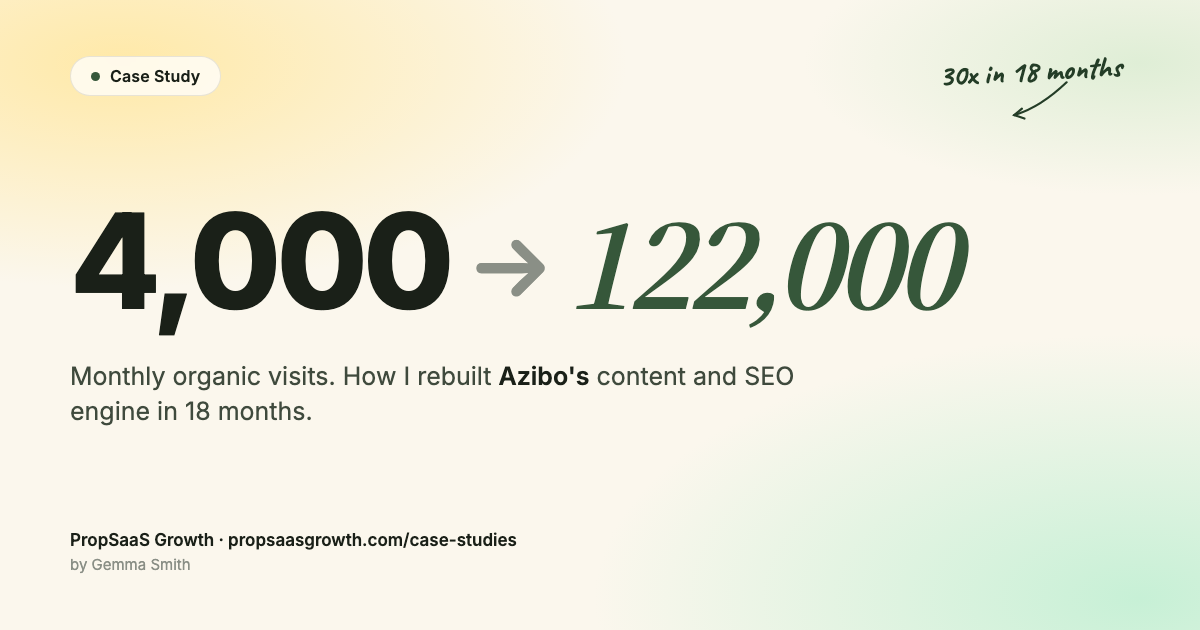
- Organic traffic: 4,000 monthly visits. Almost none of it on commercial-intent terms.
- Blog: well-meaning but unoptimized. Most posts ranked outside the top 10 for their target queries.
- Technical SEO: site health 67, with broken links, redirect chains, and meta gaps eating crawl budget.
- Backlinks: domain rating 42, 311 referring domains. Thin for a platform competing with established category players.
What Azibo needed was structure. Articles were being produced. They just weren't structured to compound, weren't anchored on the product, and weren't built to convert. The eighteen-month transformation that followed came from five strategic moves that compounded into each other. Not 30 tactics. Five.
Move 1: Topical clusters anchored on product features
The first move was restructuring the blog around clusters that mapped 1:1 to Azibo's product features. Every cluster owned a specific surface area of the buyer's day, and every piece of content inside the cluster had a defined job:
- Anchor posts (3,000+ words): the central long-form resource for each topic. Example: The Ultimate Guide to Efficient Rent Collection as the anchor for the rent collection cluster.
- Informational posts: shorter, query-specific articles answering common landlord questions. Example: How Often Can a Landlord Raise Rent?
- Linkable assets: data-driven posts engineered to attract backlinks. Example: Average Rent Increase Per Year: Everything You Need to Know.
- Transactional posts: solution-framed content showing the product as the answer. Example: How Azibo Solves the Pain Points of Rent Collection.
The cluster architecture meant every post had a defined internal-linking job. Rankings compounded across the cluster instead of in isolation. By month six, the rent collection cluster was generating organic sign-ups daily.
Move 2: Lead magnets as conversion infrastructure
Most blog content treats lead capture as an afterthought. We treated it as infrastructure:
- Every cluster had a tailored downloadable resource. Example: Dealing with Difficult Situations: A Rent Collection Guide. Practical advice not available in the blog itself, so the download carried real perceived value.
- HubSpot forms embedded inline, with hidden fields capturing which cluster the user had engaged with.
- Hidden fields fed email segmentation. Landlords downloading the rent collection guide entered a different nurture sequence than landlords downloading the lease management guide.
In parallel, The Rental Rundown weekly newsletter went from zero subscribers to nearly 5,000 in twelve months, sourced entirely from blog CTAs and lead-magnet downloads. The list itself became a distribution asset for everything we published next.
Move 3: State-specific content for legal SEO
Landlord-tenant law is state-specific. Search demand is state-specific. Most generic landlord content ignores this and gives advice that's correct in some states and technically illegal in others.
We built a clickable U.S. map linking to state-specific legal resource pages, prioritized by where Azibo already had user concentration: California, New York, Texas, and Florida first. Each state page covered the specific rules a landlord in that state actually needed.
This served two outcomes simultaneously. Real value to existing users (no more guessing whether the rent-increase advice they were reading applied to them) and ranking opportunities for high-intent, geographically-scoped queries that the generic landlord blogs weren't competing for.
Move 4: Technical foundation cleanup
A site with a 67 health score is leaking equity. The work wasn't glamorous and it was non-negotiable:
- Fixed 404s and redirect chains.
- Optimized images and added alt text.
- Tightened meta descriptions, titles, and canonical tags site-wide.
- Eliminated orphaned pages and confirmed every internal link was functional.
- Added structured data: FAQ schema, review schema, article schema. Earned rich results for priority pages.
Site health climbed from 67 to 95 across the engagement. The compounding here is invisible until you measure it. The same content ranks higher and converts better when the technical surface isn't actively pushing it down.
Move 5: Content velocity at scale
To close the topical-authority gap with established competitors, the team published 15 articles per week, three per day, five days a week, during the initial six-month phase. This was a deliberate choice and a hard one. Hiring, briefing, editing, and QA all had to be built simultaneously.
Two patterns made it sustainable:
- Briefs over drafts. Every article started from a structured brief (query, intent, outline, internal links, embedded CTA). Writers worked from briefs, not from blank pages.
- Embedded conversion-asset articles. Posts like Rent Reminder Letter Templates included editable downloads that drove email sign-ups inline. The article ranked and converted in the same impression.
By the end of the initial scale phase, the cluster architecture was dense enough that the velocity could drop to a sustainable cadence without losing momentum. Volume bought authority; structure compounded it.
Treat content as conversion infrastructure. Every piece, every cluster, every link inside the system, has a defined job. That is what compounds.
What I'd do differently in 2026
The playbook above still works. The architecture (clusters anchored on product features, lead magnets wired into the content, technical foundation, deliberate velocity) hasn't changed. What has changed is the surface buyers hit first.
In 2023, a landlord searching for rent-collection advice typed it into Google. By 2026, an increasing share opens ChatGPT, Claude, Perplexity, or Google's AI Overviews first. The 2023 test for content was "can I rank for this query." The 2026 test is "will AI cite me when this question comes up." Most of the Azibo playbook ports forward to that test. Three things would change at the engagement start:
- Citation-readiness on day one. Every anchor post would be structured for direct-answer extraction in the first 60 words. FAQ blocks would be Q-and-A format from the start. Article + FAQPage schema and entity bindings would be deployed from the first published post, not retrofitted at month nine.
- Off-site citation work as a parallel discipline. The Azibo playbook focused on owned content and backlinks. In 2026, where AI engines look for sources also includes Reddit threads, podcast appearances, G2 reviews, Wikipedia entries, and YouTube transcripts. Off-site work has become essential. It determines whether AI can find you as a source before it ever crawls your site.
- Brand-mention monitoring from week one. "What does ChatGPT say when someone asks about Azibo?" would be a baseline measurement at engagement start. Without that measurement, you can't tell whether your content is moving the answer or just adding noise. The Azibo engagement had organic-traffic dashboards but no AI-citation tracking. That would be the first thing built now.
The core insight from Azibo holds. Content compounds when every piece has a structural job and every cluster has a strategic purpose. What's added in 2026 is a second surface (AI engines) you have to be visible on simultaneously. The work to do that overlaps heavily with what made Azibo work in the first place. Same playbook, wider definition of where citations come from.

Gemma Smith, Founder, PropSaaS Growth
SEO, AEO, and content strategy for PropTech, FinTech, and B2B SaaS companies. 10+ years in PropTech. Active engagements with vertical SaaS platforms.