
What kind of B2B SaaS content gets cited most reliably by AI search engines? Comparison pages. "Brand A vs Brand B vs Brand C" pages match a specific buyer query pattern, constrain the engine's answer space, and are easy for engines to lift from. They are also one of the surfaces most B2B SaaS teams write badly. The pages that win AI citation look different from the ones most teams ship. Here is the pattern, the playbook, and the five mistakes that kill citation.
The comparison archetype is the second of the five prompts in our B2B SaaS AI prompt set. This is the post on how to write the page that wins it. For the broader keyword-research framework that surfaces which comparisons to write in the first place, see our piece on finding buyer intent keywords that drive SaaS revenue.
Why AI engines lean on comparison pages so heavily
Three reasons.
Constrained-answer queries. When a buyer types "Brand A vs Brand B" into ChatGPT, the engine knows it needs to compare two named entities. The answer space is bounded. Engines prefer to cite a single source that does the comparison well rather than synthesize one from scratch. A clean comparison page is essentially pre-synthesized content.
The brands constrain the answer. Comparison queries collapse engine variance. In our PropTech research, the same comparison query produced near-identical brand lists across ChatGPT, Perplexity, Claude, and Gemini. Engine personality matters less when the brands in the query do the constraining. A comparison page that ranks for the query wins on all four engines, not just one.
The DoorLoop pattern. In the same research, DoorLoop landed AI citations at roughly the same rate as much larger competitors. The structural reason: they publish their own comparison pages including themselves as the third option in established duopoly conversations. "Buildium vs AppFolio vs DoorLoop" exists as a DoorLoop-authored page that is both useful and earnest enough to earn citation. The smaller brand published the comparison the bigger brands would not.
The smaller-brand comparison page wins because it does the comparison the bigger brands refuse to do honestly. That refusal is the gap.
The URL pattern that works
The slug is the first signal. Comparison queries hit URLs that contain the exact phrase. Three patterns work for B2B SaaS:
- Two-brand:
/brand-a-vs-brand-b/ - Three-brand with self:
/brand-a-vs-brand-b-vs-yourbrand/ - Alternatives hub:
/yourbrand-alternatives/or/best-brand-a-alternatives/
The three-brand-with-self pattern tends to win the most citation traffic for B2B SaaS because it includes both the established comparison query (Brand A vs Brand B) and your own brand in the same URL. Engines crawling for the query match the slug exactly; engines synthesizing the answer find your brand inside the comparison content.
A common mistake: nesting these under /blog/ or /resources/. Comparison pages are landing pages, not blog posts. They live at the root URL level, the same way product or solution pages do. The URL is what wins the citation match.
One more trap once the slug is right: make sure the page resolves to a single canonical URL. If the same comparison page is reachable with and without a trailing slash or with tracking parameters appended, AI engines can cite a non-preferred variant or split citation credit across versions. The fix is signal consolidation, covered in the guide to fixing SaaS canonical conflicts.
The page structure (with template)
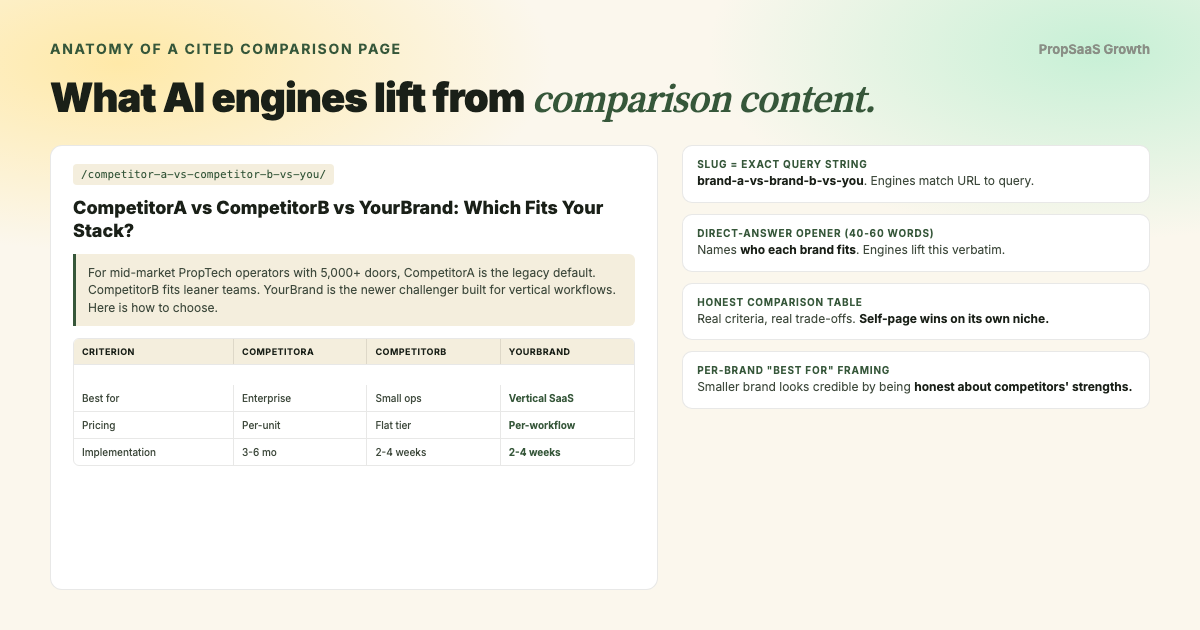
A cited comparison page has six structural elements. Each does a specific citation job. Before you build the page, settle the angle and the competitor framing in a content brief, because structure without that strategic direction produces an organized page that misses the buyer's real decision criteria.
1. Direct-answer opener (40-60 words)
First paragraph names which brand fits which buyer. Example: "For mid-market PropTech operators with 5,000+ doors, Brand A is the legacy default. Brand B fits leaner teams. YourBrand is the newer challenger built for vertical workflows." Engines lift this verbatim into responses.
2. At-a-glance comparison table
Four to six rows, three to five columns. Real criteria (best for, pricing model, implementation time, integrations, support). Each brand wins one row and loses one row. Engines parse table cells into answer fragments and weight the page on perceived honesty.
3. Per-brand "best for" sections
One section per brand. Heading is the brand name. First sentence is "best for [specific buyer]." Then strengths, then weaknesses, then pricing context. Critically: your competitors get fair sections, not strawman framings. Engines weight pages that read as honest, which means the competitor sections need to be the sections a buyer of that competitor would also read as accurate.
4. "How to decide" framework
A short decision section: "If you have X, pick Brand A. If you have Y, pick Brand B. If you have Z, pick YourBrand." Engines lift this for "how do I choose between X and Y" follow-up queries that branch off the original comparison.
5. FAQ block
Five to seven questions buyers actually ask inside this comparison. "Is Brand A more expensive than Brand B?" "Can YourBrand replace Brand A for [specific use case]?" "Which integrates with Salesforce out of the box?" Engines lift FAQ answers directly into responses.
6. Schema stack
Article + BreadcrumbList + FAQPage at minimum. Product schema if you sell a specific product. Service schema if you provide one. Schema fires engine recognition; without it, engines have to infer the page type, and inference is unreliable.
The smaller-brand pattern (the DoorLoop play)
If you are not the established duopoly in your category, the comparison page is one of the cheapest leverage points available. Three principles.
Include yourself as the third option in established comparisons. Do not write "YourBrand vs Brand A" if buyers do not yet think of you as Brand A's competitor. Write "Brand A vs Brand B vs YourBrand" and earn your way into the consideration set by being included in the comparison they are already running.
Be earnest about competitor strengths. A smaller brand earning citation does so by being more honest than the bigger brand's own marketing. "Brand A is the legacy default with the deepest integration catalog" reads as more credible than "Brand A is bloated and expensive." Engines recognize earnest comparison content and weight it higher than biased framings, regardless of which brand published the page.
Write the page even if you would lose on a feature-for-feature row. The point is not to be the right answer for every buyer. The point is to be the cited source for the comparison query, and to win the buyers your product genuinely fits. A page that says "Brand A is better for enterprise; YourBrand is better for vertical workflows" earns you the vertical-workflow buyer and concedes the enterprise one. That concession is what makes the page citeable in the first place.
The trap to avoid: comparison-spam. Some brands publish a comparison page per competitor (50+ pages for 50+ competitors), each generated from a template, each thin. Engines deprioritize content patterns at scale. Five well-written comparison pages on the right competitor matchups beat fifty thin ones.
Five mistakes that kill AI citation on comparison pages
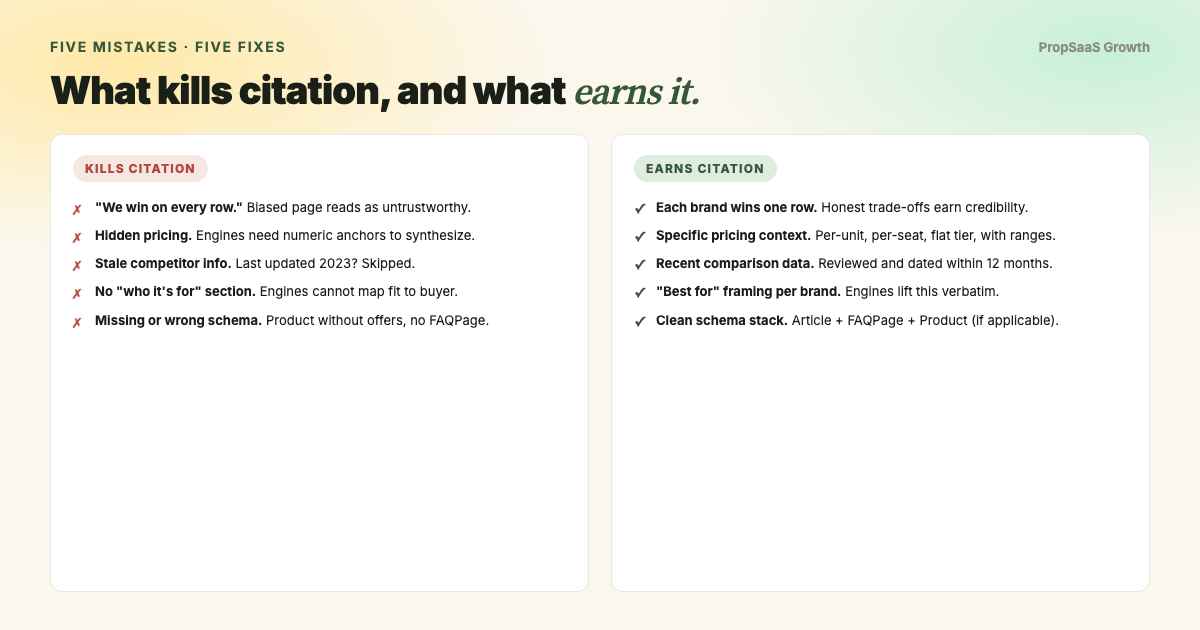
Five anti-patterns that fail reliably:
- "We win on every row." The biased framing reads as untrustworthy to humans and to engines. The page loses citation the moment a buyer compares it against the named competitor's own marketing and the bias is visible.
- Hidden pricing. Engines synthesizing answers need numeric anchors. "Contact sales" rows leave the engine with no comparison signal on the pricing axis, and engines often skip the page entirely rather than cite a partial comparison.
- Stale competitor information. If you wrote "Brand A does not support X" in 2023 and Brand A shipped X in 2024, your comparison is wrong. Engines crawl recently; out-of-date comparisons get filtered out.
- No "who it's for" section. Without a per-brand best-for framing, the engine cannot synthesize fit-to-buyer matching. Comparison tables alone are not enough.
- Missing or wrong schema. A Product without
offers, a comparison page without Article and FAQPage schema, breadcrumbs without BreadcrumbList. Engines need the schema to confirm what they are reading.
The five fixes are the inverse: honest trade-offs, specific pricing context, recent data, per-brand best-for framing, and a clean schema stack. Each fix maps directly to one of the mistakes.
How to measure if your comparison page is working
Three signals to track:
- Direct citation in your prompt set. Run "[Brand A] vs [Brand B]" and "[Brand A] vs [Brand B] vs YourBrand" through ChatGPT, Perplexity, Claude, and Gemini weekly. Log every page cited. If your page is among them, you are winning that query.
- Brand inclusion in the synthesized answer. Even when your page is not cited, your brand may be named alongside the established duopoly. That is the entry signal: engines are starting to see you as a comparison participant.
- Search Console for the comparison query. Comparison queries appear in GSC the same as any other query. Watch impressions on the "[Brand A] vs [Brand B]" terms; impression growth correlates with the page being indexed for the query, which is a prerequisite to AI citation.
The full measurement stack (GA4 plus GSC plus citation tracking) lives in our guide to measuring AI visibility. Comparison-page measurement is one slice of that broader stack.
The takeaway
Comparison pages are one of the highest-leverage AEO surfaces for B2B SaaS, but most pages are written for the wrong audience. The biased "we win on every row" framing optimizes for the marketing team's instinct. The honest "each brand wins one row" framing optimizes for the engine's citation criteria and for the buyer's real decision. Those two framings are different, and one of them earns AI citation while the other gets skipped.
If you are not the established duopoly in your category, the smaller-brand pattern is the cheapest leverage point: publish "Brand A vs Brand B vs YourBrand" earnestly, include yourself fairly, and let the engines do the work of routing buyers to you when your product fits.
Frequently asked questions
How many comparison pages should a B2B SaaS company have?
Start with the three to five comparison queries your buyers actually run, not the fifty competitors in your space. Five well-written comparison pages on real competitor matchups beat fifty thin pages generated from a template. Quality over coverage. You can always add pages as new competitor mentions appear in your prompt set tracking.
Should I include myself in every comparison page?
Yes, for B2B SaaS comparison pages on your own site. The whole point of publishing a comparison page is to earn citation in your category, and citation requires the engines to see your brand as part of the comparison set. Including yourself as the third option in "Brand A vs Brand B" is the standard pattern.
Do comparison pages work for niche or vertical SaaS where there is no established duopoly?
Yes, with adjustment. If your category does not have an established "X vs Y" search pattern yet, write "[Job to be done] software" comparison pages comparing 4 to 6 named competitors instead. The buyer query is still constrained ("best software for X"), and your page can be the citeable answer to that query the same way duopoly comparisons are citeable in established categories.
How often should I update a comparison page?
Every six months at minimum, sooner if a named competitor ships a major release or changes pricing. Out-of-date comparison data is one of the five mistakes that kill citation, and the cost of letting a comparison go stale is the engine quietly deprioritizing the page.
What schema should I use on a comparison page?
Article + BreadcrumbList + FAQPage as the baseline stack. Add Product schema with offers if you sell a specific product on the page. Add Service schema if you sell a service. If the page reviews the brands explicitly, Review schema can be appropriate. Avoid stacking schema that does not match the page content; engines flag mismatched schema as a quality signal against the page.

Gemma Smith, Founder, PropSaaS Growth
SEO, AEO, and content strategy for PropTech, FinTech, and B2B SaaS companies. 10+ years in PropTech. Active engagements with vertical SaaS platforms. AirOps Champion.