
A founder I talked to recently had just done what most B2B SaaS marketing teams are doing with AEO: added FAQ schema, set up an llms.txt file, built a "Summarize with AI" button on their homepage. Five tactics, all checked off the list. Then I asked what their buyers were actually asking ChatGPT about their category. They paused. "I… haven't checked."
That's the gap. Most teams are adopting AEO as a checklist of technical moves they read about in a newsletter. They're not asking the question AEO is actually supposed to answer: when a buyer types a problem into an AI assistant, does the model know who we are, and does it describe us accurately?
AEO is also a structural foundation, the same way technical SEO is a structural foundation. In 2026, the four structural elements that drive citations on your own pages (direct-answer openings, FAQ blocks, entity signals, truth alignment) are the baseline for any B2B SaaS site building organic visibility. Two or three of them are usually present on a site already, in fragments. The compounding effect arrives once all four are present together. Off-site citation work (Reddit, Wikipedia, G2 reviews, podcast appearances, video) is its own discipline. This guide focuses on the on-page side; off-site gets its own write-up.
What is AEO (Answer Engine Optimization)?
Answer Engine Optimization (AEO) is the practice of structuring content so AI-powered answer engines, ChatGPT, Perplexity, Google's AI Overviews, Microsoft Copilot. Can extract, summarize, and cite it when users ask questions. Where SEO ranks pages to send clicks, AEO structures pages to be quoted as a source of truth. The output is a citation in someone else's answer, not a ten-blue-links ranking.
Because the term is getting stretched, a clean definition helps. AEO works through structural elements on your existing content: how you frame answers, how you mark up entities with schema, how you audit what AI assistants say about you. The label "AEO" has been around in some form since the early voice-search era. The LLM-era practice emerged in 2023-2024 as conversational AI tools went mainstream and accelerated through 2025 with Google AI Overviews. The underlying practice (making your content extractable, attributable, and trustworthy) is older than the acronym.
AEO vs SEO: what's actually different?
The simplest way to see the difference: SEO is optimized for the click, AEO is optimized for the citation. Same craft in many places (technical health, topical authority, accurate content), different finish line. SEO wins when a human clicks through to your page and stays. AEO wins when an AI assistant lifts a sentence from your page and attributes it to your brand. Whether or not the user ever visits your site.
Here's how they compare across the dimensions that matter for B2B SaaS:
| SEO (the playbook you know) | AEO (the new ranking surface) | |
|---|---|---|
| Goal | Click to your site | Quote from your site (with or without a click) |
| Ranking signal | Backlinks, on-page relevance, technical health | Citation-worthiness, entity clarity, freshness, external mentions |
| Content shape | Long-form keyword-targeted pages | Direct answers up top, structured data, quotable sentences |
| Success metric | Organic traffic, rankings, click-through | Citation rate, brand mention rate, AI-driven referral traffic |
| Time to results | 6–12 months for ranking lift | 2–6 weeks for first citations once content is published |
| Who reads the output | A human after they search | An LLM first, then a human. Or, increasingly, only an LLM |
The row that matters most for B2B SaaS founders is the last one: who reads the output. Your buyer isn't reading the AI engine's training data. They're reading the engine's answer. That answer is built from the sources the model judges most authoritative on the question they asked.
If your competitor's content is the one being quoted (even when it's less accurate, less complete, or less recent than yours), your competitor is the one getting recommended, mentioned, and shortlisted. The buyer never sees the comparison; they see whatever the model decides to show them.
That's the shift. Citation has replaced ranking as the primary signal of winning content.
Why this matters more for PropTech and FinTech than for ecom
Most B2B buyers move through five stages (Pete Kazanjy's framing): Problem Awareness, Problem Prioritization, Solution Preference, Commercial Agreement, and Championship. AEO matters most in the first three. And that's where vertical B2B SaaS in regulated markets behaves differently from ecom.
How AEO impacts each stage
- Stage 1, Problem Awareness is increasingly mediated by AI. A property manager doesn't search "best maintenance software" first. They ask ChatGPT something like "what's the best maintenance platform for a 500-unit multifamily portfolio with HUD-compliance requirements?" The buyer becomes aware their problem has a category of solution from the AI's answer, not from a Google SERP. If the model doesn't know your category accurately, your buyer's problem awareness gets framed by your competitor's positioning, before you've ever entered consideration.
- Stage 2, Problem Prioritization is where a buyer asks "is this a problem we need to solve now, or can it wait?" Increasingly, they ask an AI assistant that question too. For categories that touch money, compliance, or risk (what Google calls YMYL, Your Money or Your Life), AI engines are pickier about which sources they trust when answering. Most PropTech and FinTech sits here. The bar to be cited as a trusted authority is higher than for, say, kitchen gadgets, but the upside of clearing it is much larger. If you're not on the AI's trusted list for your category, the answer the buyer gets won't include your perspective on why now is the right time. Your competitor's will.
- Stage 3, Solution Preference is where citations decide the shortlist. In a 3–9 month sales cycle, the buyer who Googled you in month one will ask ChatGPT about you in month two, again in month four, and once more before signing. Every one of those queries is a citation opportunity or a citation loss. If AI describes your competitor in detail and you in three vague sentences, you don't make the shortlist. Even when your product is the better fit.
- Stages 4 and 5, Commercial Agreement and Championship, are largely human-mediated. AEO's direct leverage drops here. But by this point the shortlist is set. The earlier stages are where the game is won or lost.
AEO impact across the B2B buyer journey
Problem Awareness
HighProblem Prioritization
Very highSolution Preference
PeakCommercial Agreement
LowChampionship
Minimal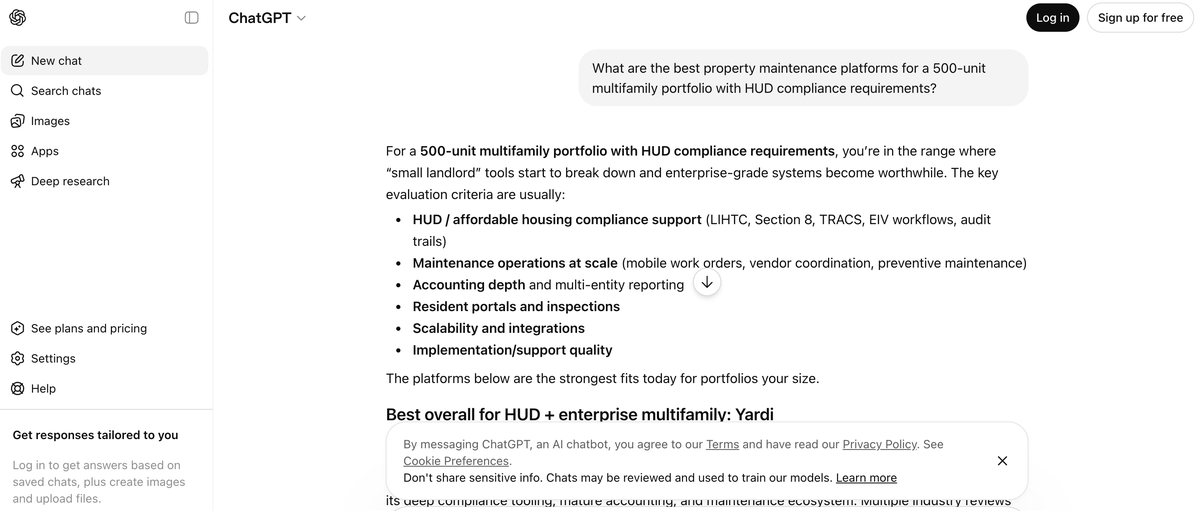
The four structural elements every AEO-ready page needs
The methodology I use across PropTech and FinTech engagements comes down to four structural elements. Every article, landing page, and topic hub gets all four, on every ship. Generic AEO advice tends to stop at one or two of these; the compounding effect only kicks in when all four are present. If ChatGPT is the engine you want to win first, our playbook on how to rank in ChatGPT walks this same structural work through that one engine. For the content-architecture layer that sits underneath (which categories of post compound, which fail), see our piece on hub-and-spoke content for B2B SaaS.
Direct-answer openings
Lead every page with a 40–80 word complete answer. LLMs extract answer candidates from the top of the page.
FAQ blocks
5–10 buyer-language questions answered in 40–120 words each. Q&A blocks are the single most-extractable element in LLM responses; FAQPage schema reinforces the signal where engines still consume structured data.
Entity signals
Named author, product, customers, adjacent entities, schema. LLMs cite entities, not URLs.
Truth alignment
Quarterly audit of how each AI describes you. The highest-leverage content work in AEO.
1. Direct-answer openings
Every article opens with a 40–80 word complete answer to the query the page is structured to own. First paragraph is the clean answer; second paragraph carries the nuance, conditions, caveats. The headline includes the question or query literally where natural. AI engines extract answer candidates from the opening. Bury the answer and the page gets skipped, regardless of how good the rest is. No marketing throat-clearing. No "in today's fast-moving landscape." Lead with the answer.
2. FAQ blocks
Every long-form post includes a structured FAQ block with 5–10 questions buyers actually ask, answered in 40–120 words each, marked up with FAQPage schema.
FAQ blocks are the single most-cited structural element in LLM responses. Each Q&A pair is an atomic answer unit the model can extract without the surrounding context. The questions have to be real user phrasings (from GSC long-tail impressions, Bing Webmaster Tools prompts, sales-call transcripts), not internal-marketing translations. If you're inventing FAQ questions in a planning meeting, they won't land.
One thing to address up front: as of May 7 2026, Google stopped showing FAQ rich results in search, and the FAQ search appearance is being fully retired in June 2026. A lot of teams have read that as "FAQ schema is dead, stop using it." That's the wrong takeaway for AEO. The visual SERP feature is gone, but the underlying structure (a clear question heading with a complete answer immediately below it, repeated) is what makes FAQ blocks the single most-extractable element on the page for AI engines. The JSON-LD reinforces that signal where engines that still consume structured data (Bing, Microsoft Copilot) can read it. Keep the FAQ blocks. Keep the schema. The mechanic that matters hasn't changed.
3. Entity signals
LLMs answer by citing entities, not URLs. A page that mentions the brand once and otherwise uses generic category terms is invisible. A page that establishes the brand alongside its named experts, products, customers, and adjacent entities (competitors where appropriate, named frameworks, named standards) becomes citable.
The technical layer: Organization + Person + Product + Article schema with author linked, sameAs pointing to LinkedIn, Crunchbase, G2, Capterra.
The strategic layer: actually be a named entity that other named entities reference. Most B2B SaaS sites are fuzzy entities. Lots of feature copy, very little crisp "this is who we are." That fuzziness shows up as bad AI summaries.
4. Truth alignment
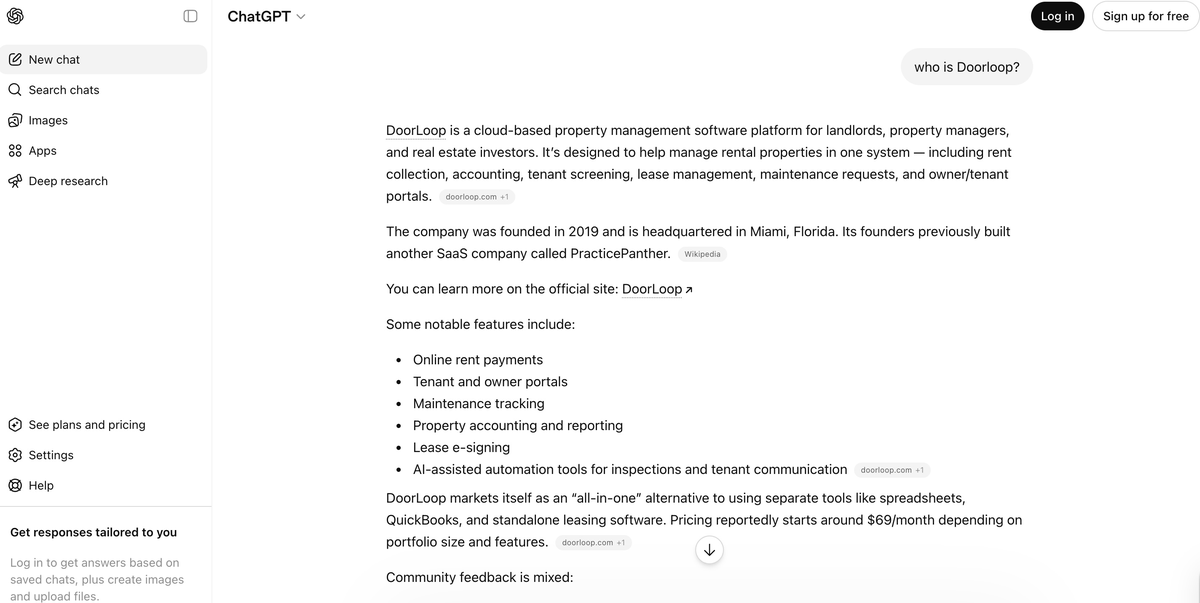
Quarterly, query ChatGPT, Perplexity, Gemini, and Claude with the questions your buyers ask about you. "What is [your brand]," "how does [your brand] compare to [competitor]," "does [your brand] do [core feature]." Capture how each model describes you.
When the description is wrong, vague, or missing, that's the highest-leverage content work available. Publish or strengthen the canonical content that corrects it. AI engines encode whatever text won the attention war on a topic. If your competitor's narrative is the one being repeated, your job is to ship the version that becomes the new reference.
This element delivers the fastest measurable impact in AEO.
One important caveat: these four work alongside traditional SEO foundations, not as a replacement. Strip keyword targeting, internal linking, or backlink work in favor of "AEO-only" and you'll kill both surfaces. AEO is the floor for everything in 2026. Not a specialization that lives separately from your core SEO practice.
AEO vs GEO vs LLM SEO: sorting the alphabet soup
You'll see three acronyms used almost interchangeably, and the inconsistency confuses buyers more than it confuses practitioners.
- AEO (Answer Engine Optimization). The broadest term. Covers any system that synthesizes an answer from sources: ChatGPT, Perplexity, Google AI Overviews, Microsoft Copilot, voice assistants, featured snippets. The umbrella label.
- GEO (Generative Engine Optimization). Specifically scopes to generative AI engines (ChatGPT, Perplexity, Claude, Gemini). Same practice as AEO, narrower scope. Coined by an academic paper in late 2023 and adopted by some agencies.
- LLM SEO / LLMO (LLM Optimization). Same scope as GEO, more practitioner-facing naming. Used more in SEO industry circles.
For B2B SaaS conversations, use AEO. It's the broadest, easiest to explain to non-technical stakeholders, and not tied to a specific engine generation. Which matters because the surface keeps changing. Don't get distracted by the terminology debate. The practice is the same regardless of what you call it: be the source AI engines cite when your buyer asks a question about your category.
What an AEO-optimized page actually looks like
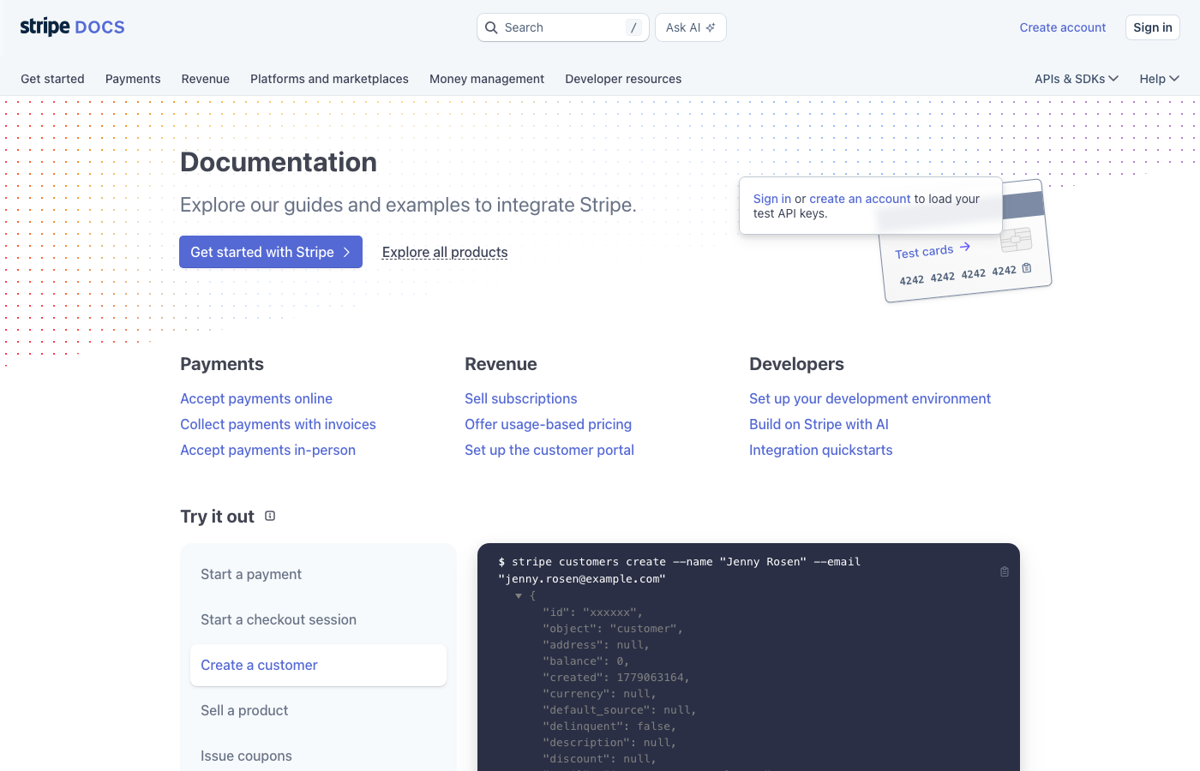
Stripe's documentation is the example most cited in AEO conversations. Ask ChatGPT or Perplexity almost any question about how payment processing works (interchange, chargebacks, PSD2, 3DS, network tokens), and Stripe's docs are almost always one of the sources the answer leans on. They didn't get there by accident.
Stripe isn't doing every one of the four structural elements on every page (their main payments overview leads with product CTAs rather than a definition, for example). But the underlying patterns are visible across the docs: extractable code samples, deep cross-linking with named anchor text, consistent entity vocabulary across pages, and very high information density. You genuinely learn something on a Stripe page that you couldn't learn from a generic competitor article. That information-gain quality is what gets a page repeatedly cited.
You don't need Stripe's engineering budget or a decade of domain authority to apply this. The structural discipline they use on their core pages is reproducible at any scale. What changes is the number of pages you treat this way, not the per-page craft. A bootstrapped PropTech site doing this on its top ten pages will out-perform a Series B PropTech site doing it on none.
The checklist for a B2B SaaS page that AI engines actually want to cite:
- H2 phrased as a question, with the first sentence answering it completely (40–60 words)
- Comparison tables for any "X vs Y" or "best X for Y" question
- JSON-LD schema (Article + FAQ at minimum; Organization on the homepage)
- Visible author byline with title and credentials, AI engines weight named experts higher than anonymous "team" bylines
- Last-updated date displayed and reflected in the schema (
dateModified) - At least one element of information gain per page. Original data, original framework, original example, or contrarian POV
- Internal links with descriptive anchor text (not "click here" or "this article")
- FAQ section at the bottom for the obvious questions a reader would still have
How to know if your AEO is working
AEO measurement is messier than SEO measurement because AI engines don't pass referrer data the way Google does. But there's a stack of signals that, taken together, tell you whether the work is moving, and how to read each of them is a guide in its own right:
- Branded search volume (GSC + Ahrefs). In my experience, the cleanest early AEO signal. Lifts 2–4 weeks before AI-referred organic traffic moves. Free to track via Search Console. If you're only going to watch one metric, watch this one. (Why the leading and lagging signals split like this: the traffic-pipeline decouple.)
- Citation rate. Of the relevant questions your buyers ask AI engines, what percentage cite you as a source? The headline number. Requires running a prompt set (10–30 buyer-style questions) on a regular cadence.
- Share of voice in AI responses. When AI engines describe your category, how often are you named vs your competitors? Tracks competitive positioning over time.
- Brand mention rate. Queries that don't directly ask about you but where your brand appears in the answer. The leading indicator you're becoming a category-default reference.
- AI-driven referral traffic in GA4. Visits from
chat.openai.com,perplexity.ai,copilot.microsoft.com, etc. Often appears as direct or organic because of how AI tools handle referrers, so segment carefully. - GSC AI Overview impressions, Google Search Console reports impressions in AI Overviews separately. A free read on the Google AI surface specifically.
- Bing Webmaster Tools prompts. Underused by most practitioners. Surfaces the ChatGPT-style queries driving impressions to your site (because ChatGPT indexes via Bing). Always register the site.
A category of dedicated AEO tools has emerged to automate these measurements at scale (citation trackers, brand-visibility platforms). If you want a tooling recommendation in the meantime, AirOps is what I currently reach for inside engagements to track AEO citations, brand mentions, and share of voice across the major AI engines. The tool surfaces the data. The interpretation, the prioritization, and the structural fixes are still strategic work, which is the engagement, not the tool. For an end-to-end example of this measurement playing out across 25 prompts and 4 engines, see our PropTech citation research. For the moment when you run the baseline on your own brand and find you are invisible, our dogfood post on running the framework against PropSaaS Growth walks through what to do next. For now, you can get most of this signal manually with a prompt-set spreadsheet and 30 minutes a week.
Measure each AI engine separately, not as one number. The research above found the engines diverge more than most teams expect. The same query produced materially different brand citations on ChatGPT, Claude, Perplexity, and Google AI Overviews. An aggregate "AI citation rate" hides which engines you're winning and which ones you're invisible on. Track each as its own line. Where you focus first depends on the gap, and the gap is engine-specific. (For a more recent 3-surface audit with verification on every named brand, see the vendor recommendation audit.)
Before the timeline, one clarification on how fast "fast" actually is. AI engines fall into two camps. Live-search engines (Perplexity, Microsoft Copilot, ChatGPT with browsing, Google AI Overviews) crawl the live web at query time and can pick up new or restructured content within weeks. Base model weights (the underlying knowledge ChatGPT has without browsing) update on much slower retraining cycles, typically quarterly or longer. The 2-to-6-week numbers below describe the live-search side. Becoming a default reference in the base models is a 6-to-12-month proposition, which is closer to the SEO timeline you already know.
Realistic timeline for live-search citation (typically. Varies by category competitiveness and your starting Domain Rating):
- Weeks 2–6: first citations land for low-competition, well-structured content where the model didn't already have a strong existing source
- Month 2: baseline citation presence across at least one AI assistant for your priority queries
- Month 3: branded-search volume measurably up from baseline. The first measurable indicator the work is compounding
- Month 6: cited in 2+ AI assistants for your top 3 priority queries
- Month 12: named-entity status. Your brand returned as a default option in category queries, not just when searched by name
In B2B SaaS, the brands AI engines describe accurately become the default options buyers consider. The ones described badly, or not at all, become invisible at exactly the stage that matters most.
See this compounding pattern in production: the Azibo case study walks through 18 months of the same architecture (clusters, lead-magnet infrastructure, technical foundation, deliberate velocity) growing organic traffic from 4,000 to 122,000 monthly visits.
The takeaway
AEO is moving fast. The four structural elements (direct-answer openings, FAQ blocks, entity signals, truth alignment) are the durable on-page work today. The specific tactics on top of them will shift as engines evolve. Anchor on the structure, not the tactics, and you'll move with the field rather than chase it.
One last thing. This is my experience. The wins, patterns, and tactics that have worked across my own engagements. AEO is new enough that nobody has the definitive playbook, me included. As the field matures and I see more, this guide will update. If something here turns out to be wrong in six months, the post will say so.
If you're weighing whether to bring this work in-house or hire it out, our guide to choosing a SaaS SEO agency covers what to look for, what retainers cost, and the AEO-specific questions worth asking before you sign.
Want help applying this on your site? See our AI Search Visibility service for the audit, source-trace and execution side.
Frequently asked questions
What does AEO stand for?
AEO stands for Answer Engine Optimization. The practice of structuring content so AI assistants like ChatGPT, Perplexity, Google's AI Overviews, and Microsoft Copilot can extract, summarize, and cite it when users ask questions. It's distinct from SEO, which optimizes pages to be ranked and clicked rather than quoted.
What's the difference between AEO and SEO?
SEO optimizes pages to be ranked and clicked by humans. AEO structures pages to be extracted and cited by AI engines, often without the user ever clicking through. They share fundamentals (E-E-A-T, technical health, topical authority), but AEO weights citation-worthiness, entity clarity, and information gain more heavily.
Do I need to choose between AEO and SEO?
No. AEO is built on SEO foundations; the work largely overlaps. If you're already doing strong SEO, adding AEO is mostly a matter of structuring answers more clearly, adding schema, and making sure AI engines can find and trust your content. Treat them as one discipline with two surfaces.
How long does AEO take to show results?
First citations typically appear within 2 to 6 weeks of publishing well-structured content on a topic where AI engines didn't already have a strong source. Material share-of-voice shifts take 3 to 6 months. Compound effects begin around month four, when one citation starts driving others.
What tools do I need for AEO?
At a minimum: Google Search Console (free, shows AI Overview impressions) and a manual prompt-set spreadsheet for tracking citations across ChatGPT, Perplexity, and others. Dedicated AEO platforms (citation trackers, brand-visibility tools) automate this at scale, but you can run early-stage AEO measurement with 30 minutes a week and no spend.

Gemma Smith, Founder, PropSaaS Growth
SEO, AEO, and content strategy for PropTech, FinTech, and B2B SaaS companies. 10+ years in PropTech. Active engagements with vertical SaaS platforms.