
The best SaaS content strategy is a structured system that maps content to pipeline, covers every stage of the buying committee's evaluation process, and earns visibility across Google, AI answer engines, and buyer communities at the same time. It starts from buyer signals (what your ideal customer profile actually asks) and builds outward into clusters, distribution, and measurement.
That sounds straightforward. In practice, most SaaS companies are stuck in a paradox. 5W PR's "SaaS Content Paradox 2026" analysis found that companies are spending more on content than ever while results plateau, pointing to structural problems in how content programs are built. Meanwhile, 56% of B2B marketers cannot attribute ROI to content efforts at all (CMI, B2B Content Marketing: Insights for 2026). Investment is rising while accountability for results stays absent.
This guide walks through the structural pattern that separates content programs producing compounding pipeline from those producing disposable traffic. It covers the buyer signal methodology, the content types that convert, the AI search integration layer most programs still skip, and the measurement framework that connects content to revenue. Every section includes specific tools, vertical examples, and the data points that make the framework actionable this quarter.
What makes SaaS content strategy different
SaaS content strategy differs from general content marketing in three structural ways: recurring revenue changes the ROI math (content compounds over subscription lifecycles), buying committees require multi-persona content (6 to 11 stakeholders per deal in B2B SaaS purchases), and AI answer engines now mediate a growing share of the discovery and evaluation process.
Recurring revenue changes the content ROI equation. When a customer pays monthly or annually for years, the value of the content that acquired them compounds across the entire subscription lifecycle. Content marketing generates approximately $3 for every $1 invested, compared to $1.80 for paid advertising (Genesys Growth, 2026). That gap widens further in SaaS because the payback extends across renewals and expansion revenue.
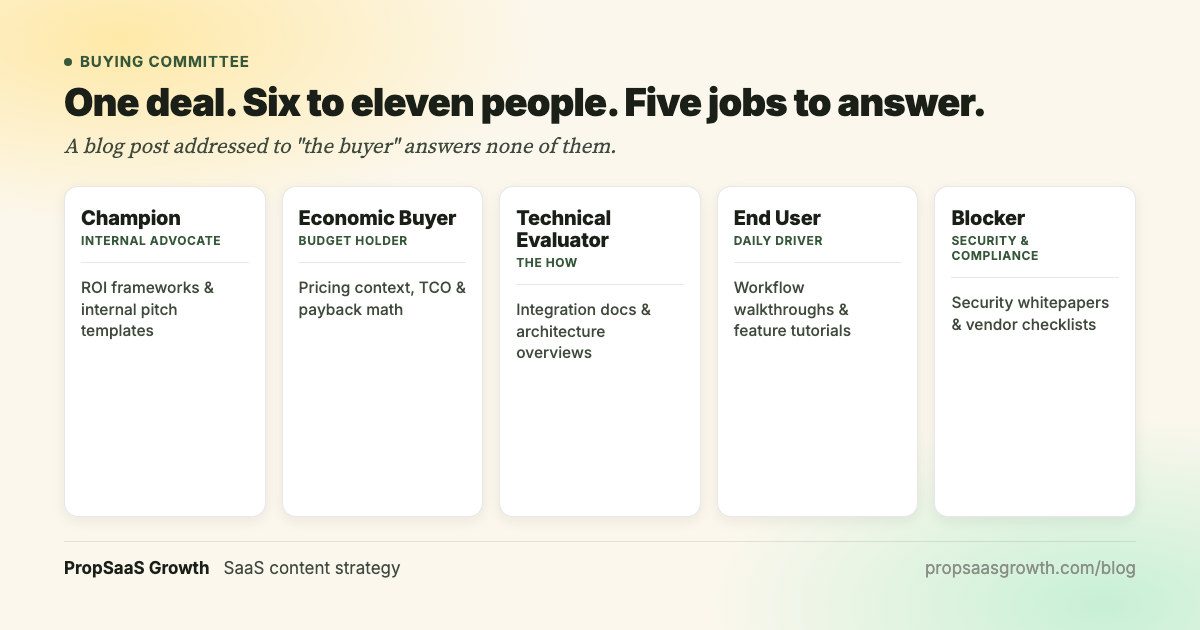
Buying committees require content built for multiple roles. B2B SaaS buying committees typically involve 6 to 11 stakeholders across 5 distinct roles: Champion, Economic Buyer, Technical Evaluator, End User, and Blocker (The Smarketers, 2026). A single blog post addressing "the buyer" misses this complexity entirely. Effective SaaS content strategy maps specific content types to each role. The Champion needs ROI justification content. The Technical Evaluator needs integration documentation and architecture overviews. The Economic Buyer needs pricing context and competitive comparisons. Each role has distinct questions, and each question requires its own content asset.
AI search fragments the discovery surface. Buyers now evaluate software across Google, ChatGPT, Perplexity, Reddit, and G2. AI content demand rose 186% among B2B buyers in the past year (Directive Consulting, 2026). Content strategy that optimizes only for Google rankings is optimizing for a shrinking share of the discovery process.
SaaS content strategy is structurally different from general content marketing because recurring revenue compounds content ROI, buying committees require content tailored to 6 to 11 stakeholders across 5 distinct roles, and AI answer engines now mediate a growing share of how buyers discover and evaluate software.
Start from buyer signals, build outward
The highest-performing SaaS content programs start from buyer signals: the language, objections, and comparison patterns that real buyers use in Reddit threads, G2 reviews, and sales calls. Keyword tools show what people search. Buyer signals show what people actually need answered before they buy.
Where buyer signals live. The richest source material sits in places most content teams overlook: Reddit subreddits where your ICP vents frustrations, G2 reviews where buyers compare your category, LinkedIn comments where practitioners debate approaches, sales call transcripts where objections surface repeatedly, and support tickets where implementation questions reveal knowledge gaps.
How to extract and cluster topics. Pull the language buyers use verbatim. In PropTech, a thread on r/CommercialRealEstate asking "how do I evaluate construction loan software when my CFO wants a 6-month payback period?" is a content topic hiding in plain sight. That thread maps to at least three content pieces: a comparison page for construction loan software, an ROI calculator targeting CFOs, and a use-case page for commercial lenders evaluating their first software purchase. Each of those maps to a different buying committee role. There is a repeatable method for turning G2 review data into buyer-language signals if you want to run this systematically.
Map clusters to buying committee roles. Each cluster should produce content for multiple stakeholders:
- Champion (internal advocate): use-case guides, ROI frameworks, and internal pitch templates.
- Economic Buyer (budget holder): pricing comparisons, TCO analyses, and payback period calculators.
- Technical Evaluator: integration documentation, API overviews, and architecture comparison pages.
- End User: workflow walkthroughs, feature tutorials, and day-in-the-life content.
- Blocker (security, compliance): security whitepapers, compliance checklists, and vendor assessment guides.
This mapping is the structural backbone of a SaaS content strategy. Directive Consulting's 2026 data reinforces why: 95% of B2B buyers are out of the market at any given time, meaning content's primary job is creating future preference. And 95% of wins start on the Day One shortlist, which forms before sales ever engages. The content that shapes that shortlist covers every role in the buying committee, across every stage of their evaluation. For the full method of mapping those roles and stages from real buyer signals, see our guide to buyer journey mapping for B2B SaaS.
SaaS content strategy starts from buyer signals extracted from Reddit, G2, and sales calls. Keyword tools show what people search. Buyer signals show what people need answered before they buy.
For a deeper look at how topic clusters function as the structural backbone of this approach, see our guide to hub-and-spoke architecture for B2B SaaS.
The content types that drive SaaS pipeline
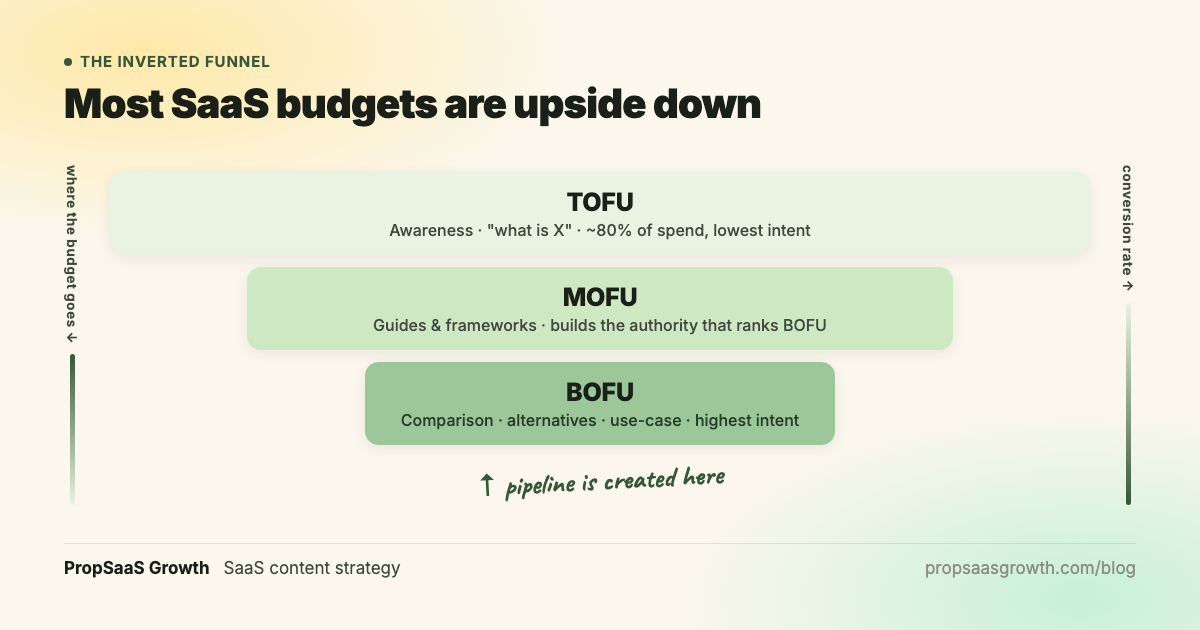
The content types that drive the most pipeline for SaaS companies are bottom-of-funnel assets: comparison pages, alternative pages, and use-case landing pages. These convert at higher rates because they reach buyers who have already identified a problem and are evaluating solutions.
Bottom-of-funnel: comparison, alternative, and use-case pages
Bottom-of-funnel (BOFU) content meets the buyer at the decision stage. The buyer already knows they have a problem, already knows the category, and is actively comparing options. This is where pipeline gets created.
Comparison pages should include a structured feature matrix, honest trade-offs (acknowledging where your product is weaker builds credibility with Technical Evaluators), pricing context at minimum a directional range, and a clear recommendation framework. In FinTech, a comparison page for "expense management software for Series B startups" converts because the buyer typing that query has budget, authority, and a timeline. They need to make a decision, and your page either helps them or it does not.
Alternative pages capture buyers actively switching from a competitor. "[Competitor] alternatives for [vertical]" is a high-converting keyword pattern in every SaaS category. These pages succeed when they lead with the buyer's likely frustrations (pulled from G2 reviews of the competitor) and map each frustration to a specific capability.
Use-case landing pages target specific verticals or workflows. For a PropTech SaaS company, "property maintenance software for mid-market multifamily" is far more pipeline-relevant than a generic product page. These pages convert because they demonstrate that you understand the buyer's specific context.
For a detailed breakdown of how to build comparison pages that earn AI citations, see our comparison page strategy for B2B SaaS.
Middle-of-funnel: guides, frameworks, and how-tos
Middle-of-funnel content establishes expertise and creates the topical authority that makes your bottom-of-funnel pages rank. This is where topic cluster architecture does its heaviest lifting.
Pillar pages serve as the structural backbone of a topic cluster. A pillar on "construction loan management" links to and from spoke pages covering specific workflows, integrations, compliance requirements, and comparison content. Google rewards this topical depth. AI engines increasingly reference pillar pages because they contain comprehensive, well-structured coverage of a subject.
How-to guides that demonstrate methodology (rather than just listing steps) build trust with Technical Evaluators and Champions. A guide titled "How to evaluate property management software for portfolios over 500 units" reaches a specific buyer with a specific problem at a specific scale.
Framework content positions your brand as the source of the model the industry uses to think about a problem. When a framework gets adopted, the brand that created it becomes the default citation.
Top-of-funnel: where most SaaS companies over-invest
Top-of-funnel content serves awareness and builds future preference. It has the longest path to revenue and receives the highest share of investment at most SaaS companies. That ratio is usually inverted from what would drive the most pipeline.
Directive Consulting's 2026 data shows that 95% of B2B buyers are out of market at any given time. TOFU content serves these buyers by building category familiarity and brand preference before they enter a buying cycle. That is a legitimate strategic function. The problem is allocating 80% of content resources to TOFU while comparison pages, alternative pages, and use-case content go unbuilt.
The right TOFU investment focuses on content that earns lasting authority: original research and benchmark data, industry reports with proprietary analysis, and survey-driven insights that create reference material. These assets earn citations, backlinks, and the kind of topical authority that lifts the entire domain. Generic "what is [category]" posts, by contrast, generate traffic without building the structural foundation for pipeline.
SaaS comparison pages, alternative pages, and use-case landing pages convert at higher rates than top-of-funnel blog posts because they reach buyers who have already identified a problem and are evaluating solutions.
Build for Google and AI answer engines at the same time
SaaS content in 2026 must earn visibility across two surfaces at once: traditional Google search and AI answer engines like ChatGPT, Perplexity, and Google AI Overviews. The structural requirements overlap significantly, but AI citation eligibility adds specific passage-level demands that most content programs ignore.
What AI engines look for in content. AI answer engines pull direct-answer passages from web content and cite the source. The passages that get cited share specific characteristics: they are self-contained (the meaning survives without the surrounding paragraphs), they name specific entities (tools, roles, frameworks, numbers), they provide direct answers to questions (rather than hedging or requiring the reader to infer), and they include scope conditions inline (stating what the claim applies to and what it does not).
How topic clusters serve both surfaces. Google rewards topical authority across a cluster of interrelated pages. AI engines reward passage-level clarity within individual pages. The structural requirements are complementary. A well-built topic cluster with clear, direct-answer passages in each spoke page earns visibility on both surfaces.
The span-liftable passage concept. Each key claim in your content must survive being quoted in isolation. If an AI engine lifts a sentence from your article and presents it as the answer to a user's question, that sentence needs to be complete, accurate, and attributed. This means writing with a dual audience in mind: the human reader scanning the full page and the AI engine extracting a single passage.
AI content demand rose 186% among B2B buyers in the past year (Directive Consulting, 2026). The SaaS companies building content that earns visibility across both surfaces have a structural advantage over those optimizing for Google rankings alone. Ask whether your content program accounts for AI answer engine visibility or treats it as an afterthought. If the answer is the latter, the gap is widening with every quarter.
SaaS content must earn visibility across both Google and AI answer engines at once. Google rewards topical authority across clusters. AI engines reward self-contained, directly stated passages that survive being quoted in isolation.
For a detailed comparison of SEO and AEO disciplines, see our guide on AEO vs. SEO for B2B SaaS. For practical guidance on earning AI citations, see how to rank in ChatGPT.
Distribution beyond search
Effective SaaS content distribution in 2026 means activating every asset across LinkedIn, email, communities, and product surfaces within the first week of publication.
LinkedIn distribution. Founder and executive posts consistently outperform company page posts in B2B SaaS. Repurpose each content piece into 2-3 LinkedIn posts: one with the key framework or data point, one with a specific example or case study insight, and one posing the question the article answers. Tag relevant people. Engage in the comments with substance.
Email and newsletter integration. Every content piece should map to a segment of your email list. A comparison page for construction loan software goes to the commercial lending segment. A framework piece on content measurement goes to the marketing leader segment. Broad-blast newsletters waste the specificity you built into the content.
Community participation. Reddit, Slack groups, and industry forums are where buyers form opinions before they ever search Google. Participate genuinely (answer questions, share insights, link to your content only when it directly answers someone's question). A PropTech SaaS company active in r/CommercialRealEstate or r/PropertyManagement builds the kind of credibility that earns both human trust and AI training data. The full playbook for earning AI citations from Reddit specifically lives in our Reddit AEO post.
Product-led distribution. In-app content recommendations, onboarding sequences that link to relevant guides, and help documentation that cross-references blog content create a distribution channel that compounds with your user base.
Publishing cadence. Quality and distribution beat volume. Two thoroughly researched, well-distributed pieces per month outperform eight shallow posts that sit unpromoted. The cadence should be sustainable for your team and aggressive enough to build topical authority within 6-12 months. For most Series A-C SaaS companies, that means 6-10 high-quality pieces per month across BOFU, MOFU, and TOFU, with a clear distribution plan for each.
SaaS content distribution means activating every asset across LinkedIn, email, communities, and product surfaces within the first week of publication. Distribution is now as important as creation.
Measure pipeline, track AI citations
The measurement framework for SaaS content strategy has expanded beyond traffic and rankings. Pipeline influence, assisted conversions, and AI citation share now sit alongside organic sessions in a complete measurement stack.
The metrics that matter. For SaaS content strategy, the metrics that connect to business outcomes are: demos sourced (first-touch attribution to content), pipeline influenced (multi-touch attribution showing content's role in deals), trial starts from organic content, expansion revenue supported by product education content, and AI citation rate across ChatGPT, Perplexity, Gemini, and Google AI Overviews.
Why attribution fails at most SaaS companies. CMI's 2025 research found that 56% of B2B marketers cannot attribute ROI to content efforts. The root cause is a measurement stack built around outputs (pages published, keywords ranking, traffic sessions) rather than outcomes (pipeline created, revenue influenced, shortlist placement). Only 36% of marketers can accurately measure content ROI at all (Genesys Growth, 2026), despite 83% identifying ROI demonstration as a core priority.
A practical attribution model. Use three lenses as complementary views:
- First-touch attribution: which content piece was the first interaction before a demo request? Track this in GA4 with conversion events mapped to demo forms and trial signups.
- Multi-touch attribution: which content pieces appeared in the journey of deals that closed? Map this through CRM touchpoint data in HubSpot or Salesforce.
- AI citation tracking: which of your pages are being cited in AI answers for your target queries? Track this with a defined prompt set run on a regular cadence across ChatGPT, Perplexity, Gemini, and Google AI Overviews.
For a PropTech SaaS company, this might mean tracking which comparison pages generated demo requests in Q1 and which blog posts were cited in ChatGPT answers about property management software.
One note on interpreting third-party statistics: findings like "content generates $3 per $1 invested" describe observed correlations across company populations. They are useful for benchmarking investment levels. They do not mean that any individual company can expect that exact return. Your results will depend on execution quality, market dynamics, and the structural factors covered in this guide.
SaaS content measurement must track pipeline influence, assisted conversions, and AI citation share alongside organic traffic. 56% of B2B marketers cannot attribute ROI to content because they track outputs (pages published) instead of outcomes (pipeline created).
For more on decoupling traffic metrics from pipeline metrics, see our guide on why traffic and pipeline decouple in B2B SaaS. For a practical AI citation tracking methodology, see how to measure AI visibility.
What we found when we ran this on our own content
PropSaaS Growth tracks 25+ prompts across ChatGPT, Perplexity, Gemini, and Google AI Overviews for our own brand and our clients. When we applied the framework described in this article to our own SaaS content, here is what the data showed.
The AI citation tracking methodology. We run a defined set of prompts on a weekly cadence across four AI surfaces. Each prompt maps to a target query that our ICP actually asks (pulled from the buyer signal methodology described earlier in this article). We track which URLs get cited, which passages get quoted, and how citation patterns shift after content updates. For the specifics of building a prompt tracking system, see our guide on building an AI prompt set for B2B SaaS.
What we observed. Pages built from buyer signals (extracted from Reddit threads, G2 reviews, and sales call transcripts) generated higher AI citation rates than pages built from keyword research alone. The buyer-signal pages contained the specific language, entities, and scope conditions that AI engines prefer to cite. The keyword-driven pages, even when well-written, tended toward category-level generality that AI engines consult for background context without citing.
When PropSaaS Growth applied this structured content strategy to Azibo, a PropTech SaaS company, the results were measurable and specific: growth from 4,000 to 122,000 monthly organic visits in 18 months, with #1-ranked keywords expanding from 34 to 1,686.
The Azibo case study. The strategy centered on cluster architecture, ICP-driven topic selection, and BOFU content prioritization. The comparison pages and use-case landing pages drove the majority of demo pipeline, while the pillar and spoke content built the topical authority that made those BOFU pages rank. For the full breakdown of how cluster architecture and content-led SEO drove that growth, see the Azibo case study.
The structural finding. The companies seeing the strongest results from content strategy in 2026 share three characteristics: they extract topics from buyer communities (rather than relying solely on keyword tools), they build content for both Google and AI answer engines from the outset, and they measure pipeline alongside traffic. The framework in this article reflects what we see working across our client portfolio in PropTech, FinTech, and vertical B2B SaaS.
Pages built from buyer signals extracted from Reddit and G2 generated higher AI citation rates than pages built from keyword research alone.
Common SaaS content strategy mistakes
The most common SaaS content strategy mistakes are structural, embedded in how the program is built rather than how individual pieces are written.
Over-investing in TOFU traffic content with no BOFU conversion layer. This is the most widespread mistake. Companies publish dozens of awareness-stage blog posts while their comparison pages, alternative pages, and use-case landing pages remain unbuilt. Traffic grows while pipeline stalls, revealing a structural gap in funnel coverage. The fix is structural: audit your content inventory by funnel stage and rebalance toward BOFU.
Building content from keyword tools alone. Keyword tools show search volume but omit the buyer intent, committee dynamics, and deal-blocking objections that content actually needs to address. Content programs built exclusively from keyword data produce content that ranks without converting. The buyer signal methodology described earlier in this article addresses this directly, and encoding it into a content brief is what carries that intent from strategy to the writer without losing it.
Ignoring AI search as a discovery surface. B2B buyers increasingly use ChatGPT, Perplexity, and Google AI Overviews during their evaluation process. AI content demand rose 186% among B2B buyers (Directive Consulting, 2026). Content programs that optimize only for traditional Google rankings are optimizing for a shrinking share of the discovery surface.
Measuring page views instead of pipeline. When the primary content KPI is traffic, the content team optimizes for traffic. That means more TOFU, more generic keyword targeting, and more volume. When the primary KPI is pipeline, the content team optimizes for conversion, buyer relevance, and attribution. The measurement section of this guide provides a practical framework for making that shift.
Running no content audit or refresh cadence. Stale content erodes domain authority and sends declining signals to both Google and AI engines. A quarterly audit cadence (evaluating what to keep, update, merge, or retire) is the minimum for a SaaS content program operating at scale. B2B buying cycles have compressed from 11.3 to 10.1 months (Directive Consulting, 2026), meaning content ages faster relative to the buying timeline.
The most common SaaS content strategy mistake is over-investing in top-of-funnel traffic content while neglecting the bottom-of-funnel comparison and alternative pages that actually convert buyers into pipeline.
The SaaS content strategy framework
Every concept in this guide distills into a single operating model with four layers. Each layer depends on the one below it. Skip a layer and the system produces traffic without pipeline.
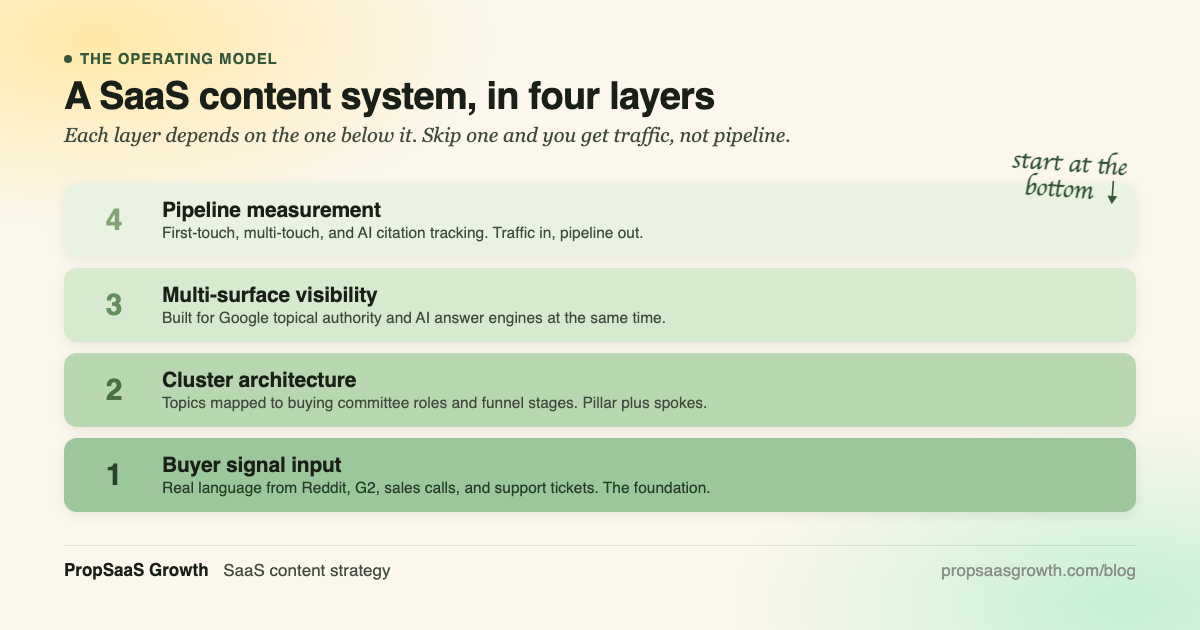
- Layer 1: Buyer signal input. Extract topics from the language, objections, and comparisons real buyers use in Reddit threads, G2 reviews, sales calls, and support tickets. This is the foundation. Keyword tools supplement this layer but cannot replace it.
- Layer 2: Cluster architecture. Organize topics into clusters mapped to buying committee roles (Champion, Economic Buyer, Technical Evaluator, End User, Blocker) and funnel stages (TOFU awareness, MOFU evaluation, BOFU decision). Each cluster produces a pillar page supported by spoke pages covering specific sub-questions.
- Layer 3: Multi-surface visibility. Build every content piece for two surfaces at once: Google (topical authority across the cluster) and AI answer engines (self-contained, span-liftable passages within each page). Each key claim names the relevant entity, states the scope condition inline, and survives being quoted in isolation.
- Layer 4: Pipeline measurement. Track three attribution lenses: first-touch (which content sourced the demo), multi-touch (which content appeared in closed deals), and AI citation (which pages are cited across ChatGPT, Perplexity, Gemini, and Google AI Overviews). Traffic is an input metric. Pipeline is the output metric.
The SaaS content strategy framework has four layers: buyer signal input, cluster architecture, multi-surface visibility, and pipeline measurement. Skip a layer and the system produces traffic without pipeline.
Action steps: your first 30 days
If your SaaS content program is producing traffic without pipeline, here is a concrete checklist to start closing the structural gap this quarter.
- Audit your content inventory by funnel stage. Count how many published pages serve TOFU (awareness), MOFU (evaluation), and BOFU (decision). If more than 70% of your content is TOFU, rebalance your next quarter's production plan toward comparison pages, alternative pages, and use-case landing pages.
- Extract buyer signals from three sources. Spend two hours in the Reddit subreddits where your ICP discusses your category, two hours reading G2 reviews of competitors in your space, and two hours reviewing the last 10 sales call recordings. Document the exact language, objections, and comparison criteria buyers use. These are your content topics.
- Map your first topic cluster to a buying committee. Choose the highest-priority topic from step 2. Build a cluster plan with one pillar page and 4-6 spoke pages, each mapped to a specific buying committee role and funnel stage.
- Write one span-liftable passage per page. For each existing page in your top cluster, add or rewrite the opening paragraph so it provides a direct, self-contained answer to the question the page targets. Name the relevant entity. State the scope condition inline. Make it quotable in isolation.
- Set up AI citation tracking. Define 10-15 prompts that your ICP asks about your category. Run them across ChatGPT, Perplexity, and Google AI Overviews on a weekly cadence. Record which URLs get cited and which passages get quoted. This is your AEO baseline.
- Connect content to pipeline in your CRM. Set up first-touch attribution for demo request forms in GA4. Map content touchpoints to deal stages in your CRM. Start reporting pipeline influenced by content alongside organic traffic in your next monthly review.
SaaS content strategy is a system. Buyer signals are the input. Topic clusters are the structure. Multi-surface distribution is the amplifier. Pipeline is the measurement. The companies winning with content in 2026 build for Google and AI answer engines at once, extract topics from buyer communities rather than relying solely on keyword tools, and measure pipeline alongside traffic. Original data and vertical expertise are the citation differentiators that separate programs that compound from programs that plateau. If your content program is producing traffic without producing pipeline, the gap is structural, and the framework in this guide provides the architecture for closing it.
Frequently asked questions
What is SaaS content marketing?
SaaS content marketing is the practice of creating and distributing content that attracts, educates, and converts software buyers across the entire subscription lifecycle. It differs from general content marketing because SaaS revenue recurs (making content ROI compound over time), buying committees involve multiple stakeholders, and the evaluation process increasingly spans AI answer engines alongside traditional search. Effective SaaS content marketing maps content to pipeline stages, buying committee roles, and the specific language buyers use during evaluation.
How long does SaaS content marketing take to show results?
Most SaaS content programs begin generating measurable organic traffic within 3-6 months. Pipeline impact typically follows in 6-12 months, depending on the competitive landscape, domain authority starting point, and how aggressively the program invests in bottom-of-funnel conversion content. Programs that lead with BOFU content (comparison pages, alternative pages, use-case landing pages) tend to see pipeline impact faster than programs that start with top-of-funnel awareness content. B2B buying cycles have compressed to 10.1 months on average (Directive Consulting, 2026), which means the content window is shortening.
How do you measure SaaS content marketing ROI?
Measure SaaS content ROI through three complementary lenses: first-touch attribution (which content piece was the first interaction before a demo request, tracked in GA4), multi-touch attribution (which content pieces appeared in the journey of closed deals, tracked through CRM data), and AI citation tracking (which pages are being cited in AI answers for your target queries). Only 36% of marketers can accurately measure content ROI (Genesys Growth, 2026). The gap is usually a measurement stack that tracks outputs rather than outcomes.
Does content marketing still work for SaaS in 2026?
Content marketing remains the highest-ROI channel for SaaS, generating approximately $3 for every $1 invested compared to $1.80 for paid advertising (Genesys Growth, 2026). The shift in 2026 is that content must now earn visibility across both Google and AI answer engines. AI content demand rose 186% among B2B buyers (Directive Consulting, 2026). Content programs that adapt to multi-surface visibility are compounding their advantage. Programs that optimize only for traditional search rankings are operating on a shrinking surface.
What is the difference between SaaS content strategy and SaaS content marketing?
SaaS content strategy is the system design: which topics to cover, which buying committee roles to target, how content maps to pipeline stages, and how measurement connects content to revenue. SaaS content marketing is the execution of that strategy: writing, publishing, distributing, and optimizing the content itself. Strategy determines what gets built and why. Marketing determines how it gets built and where it goes. Most SaaS companies invest heavily in content marketing execution while underinvesting in the strategic architecture that makes execution effective.

Gemma Smith, Founder, PropSaaS Growth
Gemma builds ICP-driven organic and AI visibility programs for B2B SaaS companies in PropTech, FinTech, and vertical software categories. 10+ years in PropTech. AirOps Champion.