
The best SaaS SEO agencies are built specifically for recurring-revenue businesses with long sales cycles, high buyer education requirements, and complex product messaging. They understand that an enterprise PropTech platform and a horizontal project management tool need entirely different keyword architectures, conversion paths, and content strategies.
That matters in 2026 more than ever. According to a 2025 Responsive survey of 350 B2B buyers, generative AI has overtaken traditional search for a quarter of B2B buyers researching vendors. AI Overviews appear in roughly 15 to 25% of Google searches, depending on the study and query type (Semrush; Conductor, 2025), reshaping how SaaS brands capture top-of-funnel intent. Hiring the wrong agency costs 12+ months of compounding time and a misallocated retainer budget.
This guide delivers a concrete evaluation framework: what separates true SaaS SEO specialists from generalists, how to evaluate and shortlist agencies, what to pay, and what results to expect. We built it from running this evaluation process ourselves, including auditing our own AI visibility and finding we were invisible (more on that below).
The agencies that generate the most pipeline in 2026 are those that integrate buyer-signal research, BOFU architecture, and AI citation visibility into a single coordinated program.
What Makes a SaaS SEO Agency Different
A SaaS SEO agency is built around the specific mechanics of software buyer journeys: long evaluation cycles, multiple stakeholders, category-level content demand, and a pipeline where most conversions happen at the bottom of the funnel. These agencies understand MRR, CAC payback, and NRR in a way that shapes every content and keyword decision.
SaaS buyers progress through awareness, consideration, and decision stages across weeks or months. Content must cover every stage with distinct intent mapping. A FinTech compliance platform and a construction management SaaS have entirely different keyword universes, buyer objections, and conversion triggers. Generic agencies miss these distinctions because they lack vertical context.
Technical SEO for SaaS includes paginated product catalogs, dynamic pricing pages, integration directories, and trial or demo conversion flows that general agencies rarely optimize correctly. JavaScript-rendered product pages, multi-tenant canonical handling, and AI crawler access requirements add complexity that a local-business SEO shop will never encounter.
Content-led SEO for SaaS targets category-defining keywords, comparison pages, and solution-aware queries. These pages tend to convert at significantly higher rates than informational traffic because they reach buyers who are already evaluating solutions. These pages reach buyers in the active evaluation stage, and they require deep product and competitive knowledge to write credibly.
SaaS SEO strategy must also account for AI search. Citations in ChatGPT, Perplexity, and Google AI Overviews now influence pipeline independent of organic click volume. AI Overviews appear in roughly 15 to 25% of searches, depending on the study (Semrush; Conductor, 2025), and agencies that ignore this channel are operating with an incomplete model. For a deeper look at how these two disciplines relate, see our piece on AEO vs. SEO for B2B SaaS.
Vertical B2B SaaS (PropTech, FinTech, construction tech) adds another layer: niche buyer vocabulary, regulatory context, and audience sizes that require precision over volume.
What the Agency Landscape Looks Like in 2026
Several agencies have built credible track records in SaaS SEO, each with different strengths across stage, vertical, and service model. The right choice depends on your company's stage, whether you need B2B or B2C expertise, and whether AI search visibility is a priority alongside traditional organic rankings.
The table below compares agencies across the criteria that matter most for SaaS buyers. Use it as a shortlist starting point, then apply the evaluation framework in the next section.
| Agency | Best For | AEO/GEO Capable | Starting Price | Notable Result |
|---|---|---|---|---|
| PropSaaS Growth | Vertical B2B SaaS (PropTech, FinTech) with integrated AEO | Yes (core service) | Foundation Audit from $5,000 | Self-audit revealed zero AI citations across five buyer archetypes, rebuilt framework from findings |
| Directive | Enterprise SaaS (Series B+) with paid + organic integration | Limited | ~$10,000/mo | Customer Generation methodology for large SaaS buying committees |
| Omniscient Digital | VC-backed SaaS scaling content-to-ARR | Limited | ~$15,000/mo | 810% increase in organic sessions (Jasper); $3.7M pipeline (Smartling) |
| Grow and Convert | Mid-market SaaS prioritizing BOFU-first content | Limited | ~$10,000/mo | Pain Point SEO methodology; BOFU content converting within first quarter |
| Kalungi | Early-stage SaaS (Seed to Series A) needing fractional marketing | No | ~$5,000/mo | Full-stack marketing team model for companies without in-house marketing leadership |
| SimpleTiger | Product-led growth SaaS | Limited | ~$5,000/mo | SEO programs built around PLG conversion flows and self-serve activation |
Here is what the landscape looks like by category:
Enterprise-Scale SaaS (Series B+)
Directive is a recognized name for enterprise SaaS, with strength in paid and organic integration for larger companies with significant budgets and complex buying committees. Their Customer Generation methodology targets revenue outcomes rather than traffic volume, making them a strong fit for SaaS companies with sales-led motions and multi-stakeholder deals. At this stage, look for agencies that can coordinate across paid, organic, and ABM channels.
Content-Led Growth
Omniscient Digital has published SaaS case studies with verifiable pipeline metrics. Their work with Jasper produced an 810% increase in organic sessions, and their Smartling engagement generated $3.7 million in pipeline through organic search. They specialize in content-to-ARR programs for VC-backed SaaS companies scaling content operations.
Grow and Convert pioneered the Pain Point SEO methodology, which prioritizes BOFU content that maps directly to buyer problems over high-volume TOFU keywords. They work best with mid-market SaaS companies that need content converting within the first quarter rather than playing a 12-month awareness game. Their case study format (evaluation framework plus named examples) is one of the more effective content models in SaaS SEO.
Early-Stage Specialists (Seed to Series A)
Kalungi offers full-stack marketing team models built for companies that need marketing leadership alongside SEO execution. At this stage, look for agencies that can operate with limited internal resources and show impact within 90 days. Kalungi's fractional CMO model fills both the strategic and execution gaps that early-stage SaaS companies face.
Product-Led Growth
SimpleTiger builds SEO programs around product-led growth conversion flows, targeting self-serve activation and expansion revenue. They work well with SaaS products where the user journey from search to signup is short and conversion happens without a sales team.
Vertical B2B SaaS With Integrated AEO
PropSaaS Growth focuses on AI-first organic growth for PropTech, FinTech, and vertical B2B SaaS. The approach runs SEO and AEO as a single coordinated program through a six-part system: SEO and AEO Strategy, Content Production, AI Search Visibility, Technical SEO, Thought Leadership, and ICP Intelligence.
Two things to be honest about. First, PropSaaS Growth is a boutique operation, not a scaled agency. That means senior practitioners do the work directly, but capacity is limited. Second, when we ran our own AEO framework against our brand in May 2026, we found zero AI citations across five buyer archetypes. Complete invisibility. That finding reshaped the framework we now recommend to clients (see the full account in the section below).
Engagements are laddered: Foundation Audit, then Growth Strategy Build, then Monthly Growth Retainer. The Foundation Audit is the entry point for teams that want to assess their organic and AI visibility position before committing to a retainer. Start with a Foundation Audit to map your fastest-moving wins.
The best fit depends on stage, vertical, and budget range, which is covered in the pricing section below. Use the evaluation framework in the next section to cut through agency positioning and assess actual capability.
How to Evaluate a SaaS SEO Agency Before You Hire
Evaluating a SaaS SEO agency means asking about vertical experience, team structure, AI search capability, and how they measure success. The six questions below cut through sales messaging and reveal whether the agency can actually move pipeline for a SaaS business.
Six Questions to Ask Every SaaS SEO Agency
- What SaaS verticals have you worked in, and can you share traffic-to-pipeline case studies? Look for pipeline attribution data and specific vertical experience (PropTech, FinTech, B2B SaaS). The metric that matters is organic-to-demo or organic-to-trial attribution.
- How do you approach BOFU content versus TOFU content? The best SaaS SEO agencies can describe a clear BOFU content strategy (comparison pages, alternative pages, use-case landing pages) and explain how it connects to demo requests or trial signups.
- Do you track AI citation share in ChatGPT, Perplexity, and Google AI Overviews alongside organic rankings? If the answer is no, the agency is working with a 2023 model. For context on what this tracking looks like, see our guide on how to rank in ChatGPT.
- Who will actually work on my account, and what is their SaaS marketing background? "Senior strategy, junior execution" is common. Ask for names and LinkedIn profiles of the people doing the day-to-day work.
- What does your onboarding process look like, and what do you need from our team? Agencies that skip ICP research and buyer vocabulary mapping during onboarding will produce off-target content briefs for months.
- What does a realistic 90-day outcome look like, and what does 12-month success look like? Expect honest answers here. Agencies that promise rankings in 30 days are either misleading you or targeting trivially easy keywords.
An agency's answer to questions one and two reveals whether their keyword research comes from buyer signals (Reddit threads, G2 reviews, sales call transcripts) or from tool-generated keyword lists. The difference shows up in content relevance within the first quarter.
SaaS SEO Agency Pricing: What to Expect in 2026
SaaS SEO retainer pricing in 2026 ranges from $3,000/month for early-stage companies to $25,000/month or more for enterprise programs with full content, technical, and AI visibility coverage (Discovered Labs, February 2026). Stage, competitive intensity, and the scope of content production are the three main drivers of where a retainer lands in that range.
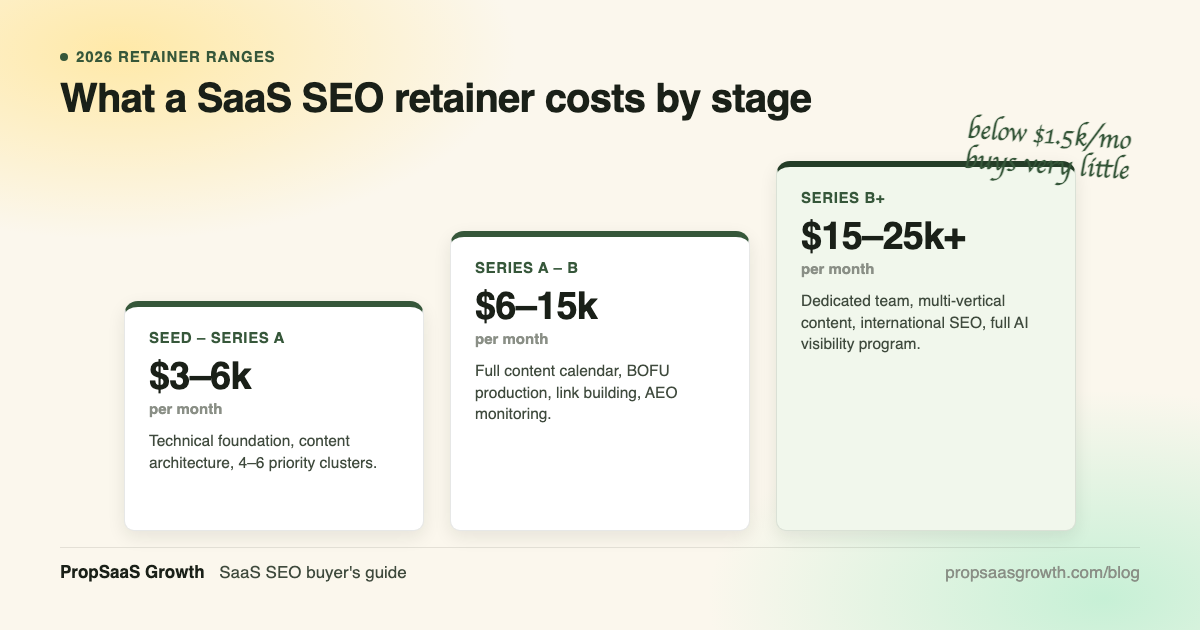
Here is how it breaks down by stage:
- Early-stage (Seed to Series A): $3,000 to $6,000/month. Focus on foundational technical SEO, initial content architecture, and 4 to 6 priority keyword clusters. At this stage, anything below $1,500/month limits what an agency can realistically deliver (Discovered Labs, 2026).
- Growth-stage (Series A to B): $6,000 to $15,000/month. Expands to full content calendar, BOFU content production, link building, and AEO monitoring.
- Enterprise (Series B+): $15,000 to $25,000+/month. Includes dedicated team, multi-vertical content, international SEO, and full AI search visibility program.
- Project-based work (audits, content strategy sprints): $5,000 to $20,000 depending on scope.
For reference, the average agency SEO retainer across all verticals is approximately $3,209/month (Ahrefs poll of 439 SEO providers, 2024). SaaS-specific engagements tend to sit above that average because of the technical complexity and content depth required.
A structured audit engagement ($5,000 to $15,000 depending on scope) is a low-risk entry point for teams evaluating whether a full retainer is the right next step. It gives you a concrete deliverable to evaluate the agency's thinking before committing to months of spend.
KPIs Your SaaS SEO Agency Should Be Tracking
A SaaS SEO agency should report on demo requests from organic, trial signups, BOFU content conversion rates, AI citation share in key AI search tools, and keyword coverage across the full buyer journey. These metrics connect organic growth to pipeline.
Here is a four-tier KPI framework:
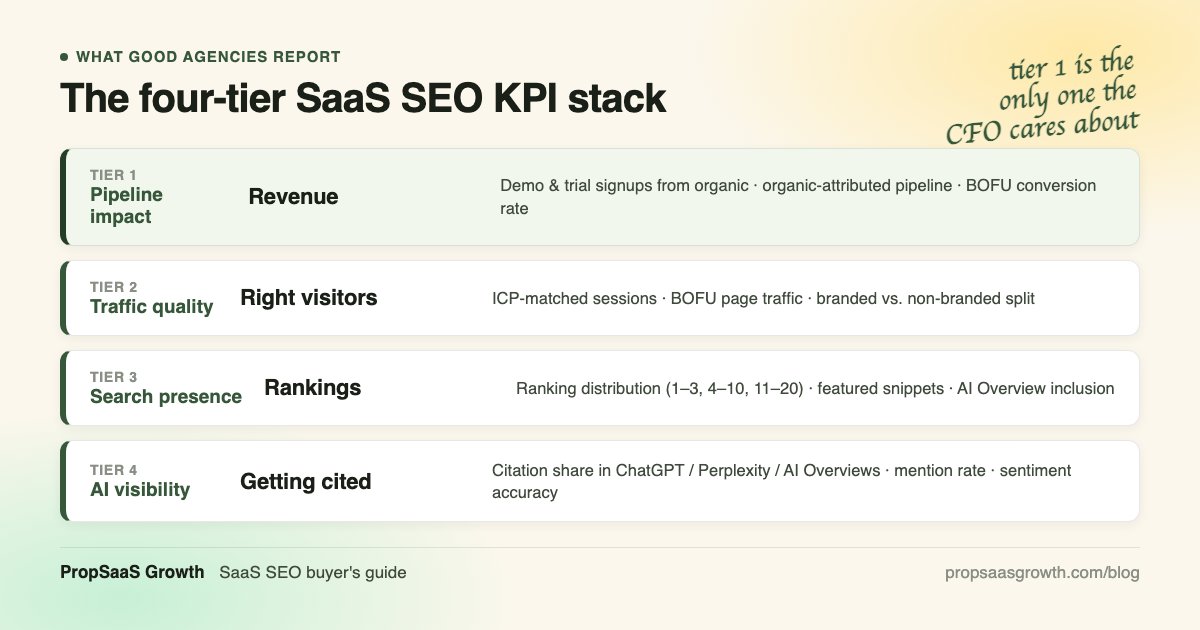
Tier 1: Pipeline Impact
- Demo requests from organic traffic
- Trial signups from organic traffic
- Organic-attributed pipeline value
- BOFU page conversion rate
Tier 2: Traffic Quality
- Organic sessions from target ICP (filtered by persona or company size in GA4)
- BOFU page traffic volume
- Branded vs. non-branded organic split
Tier 3: Search Presence
- Keyword ranking distribution (positions 1 to 3, 4 to 10, 11 to 20)
- Featured snippet wins
- AI Overview inclusion rate for target queries
Tier 4: AI Visibility
- AI citation share in ChatGPT, Perplexity, and Google AI Overviews for target queries
- Mention rate in AI-generated answers
- Sentiment accuracy in AI descriptions of your brand
Seer Interactive's 2025 study found that brands appearing in AI Overview citations showed 35% higher organic CTR than uncited brands on the same queries. Tracking all four tiers ensures the agency connects SEO to revenue at every level. For more on measuring this, see our guide on how to measure AI visibility.
Any agency worth a growth-stage retainer should be reporting on all four tiers from month one.
B2B vs. B2C SaaS SEO: How Agency Specialization Differs
B2B SaaS SEO targets decision committees with 3 to 7 stakeholders, long evaluation windows, and keyword clusters anchored in ROI, integration, and compliance. B2C SaaS SEO targets individual users with high volume, low-friction conversion paths. The agency you need depends entirely on which motion your product is built around.
B2B SaaS SEO priorities:
- Solution-aware and evaluation-stage content (comparison pages, ROI calculators, integration pages)
- Enterprise personas and multi-stakeholder buying journeys
- Compliance-aware messaging (critical for PropTech and FinTech)
- Lower keyword volumes with higher conversion value per click
B2C SaaS SEO priorities:
- High-volume keyword targeting and product-led growth content
- Review-site presence and app store optimization
- Lower-complexity sales cycles with direct self-serve conversion
Vertical B2B SaaS (PropTech, FinTech, construction tech) adds further complexity. A PropTech audience uses different language than a generic HR software buyer. Regulatory vocabulary, niche community dynamics (specific Reddit threads, industry-specific G2 categories), and audience sizes that may be in the thousands require an agency that can operate with precision at low volumes.
Most generalist agencies can handle B2C SaaS. Vertical B2B SaaS requires domain knowledge to write credibly and rank in niche communities. If your product serves a regulated vertical, the agency's category expertise is the differentiator.
Technical SEO vs. Content-Led SEO for SaaS Companies
Both technical SEO and content-led SEO are required for SaaS organic growth. Technical SEO ensures the product's dynamic pages, trial flows, and integration directories are indexable and crawlable. Content-led SEO builds the keyword coverage that pulls buyers in at awareness, consideration, and decision stages. Strong agencies coordinate both.
Technical SEO for SaaS includes:
- Core Web Vitals optimization for app-adjacent pages
- JavaScript rendering for product pages and dashboards
- Dynamic URL management (pricing pages, integration directories)
- Canonical handling for multi-tenant SaaS products
- Structured data and schema markup for AI crawler access
Content-led SEO for SaaS includes:
- Hub-and-spoke content architecture (see our guide on hub and spoke for B2B SaaS)
- Category-defining content and thought leadership
- Comparison and alternative pages (see our piece on comparison pages for B2B SaaS AEO)
- Use-case landing pages tied to ICP verticals
Technical audit and fixes should come before content expansion. Fixing crawlability, indexing, and structured data issues before scaling content prevents a common failure mode where published content never reaches its ranking potential because the technical foundation is broken. Any SaaS SEO agency that leads with content volume before completing a technical audit is building on an unreliable foundation.
Vertical SaaS adds technical complexity that generalist agencies often miss. PropTech platforms frequently have dynamic property listing pages that need careful crawl budget management. FinTech platforms have compliance-sensitive content that requires indexing controls. These are the details that separate a SaaS SEO agency from a general SEO firm.
AEO and AI Search Visibility: The Evaluation Criterion Most Buyers Miss
Answer Engine Optimization (AEO) is the practice of structuring content so AI tools like ChatGPT, Perplexity, and Google AI Overviews cite your brand in their answers. In 2025, AI Overviews appear in roughly 15 to 25% of all searches, depending on the study (Semrush; Conductor), and organic CTR on those queries has fallen 61% (Seer Interactive, 2025). Agencies that track only traditional rankings are missing a growing share of buyer attention.
The key data points for evaluating AEO impact:
The threat: Organic CTR on informational queries with AI Overviews fell from 1.76% to 0.61%, a 61% decline (Seer Interactive, September 2025). For SaaS companies that rely on educational content to fill the top of the funnel, this is a structural shift in how that content performs.
The opportunity: In the same Seer Interactive study, brands that appeared in AI Overview citations showed 35% higher organic CTR than uncited brands on the same queries. Correlation is not proof of causation, but the pattern is consistent enough that tracking AI citation status alongside CTR is now a baseline measurement requirement.
The scale: 2 to 6% of B2B web traffic is already AI-generated, growing at 40%+ per month (Forrester via DigitalCommerce360, 2025). This percentage is still small, but the growth rate means it will be a material channel within 12 months.
The distribution: the large majority of AI citations come from sources outside Tier-1 media, with brand-owned, niche, and earned sources dominating the mix (Profound, 2025). Specialized, authoritative SaaS content has a real shot at earning citations, because AI engines cite niche expertise, vertical authority, and community discussion threads alongside major publications.
When evaluating a SaaS SEO agency, ask these AEO-specific questions: Does the agency structure content for AI extraction (Q&A format, definition headers, span-liftable claims)? Do they track citation share in ChatGPT and Perplexity as a KPI? Can they show you how their content performs in AI-generated answers?
For more on how SEO and AEO work together in practice, see our pieces on AEO vs. SEO for B2B SaaS and the B2B SaaS AI prompt set.
BOFU vs. TOFU Content Strategy for SaaS
TOFU (top-of-funnel) content builds category awareness and organic traffic volume. BOFU (bottom-of-funnel) content captures buyers who are actively evaluating vendors. For most SaaS companies, BOFU content produces disproportionate pipeline impact relative to word count invested, because it reaches buyers closest to a purchase decision.
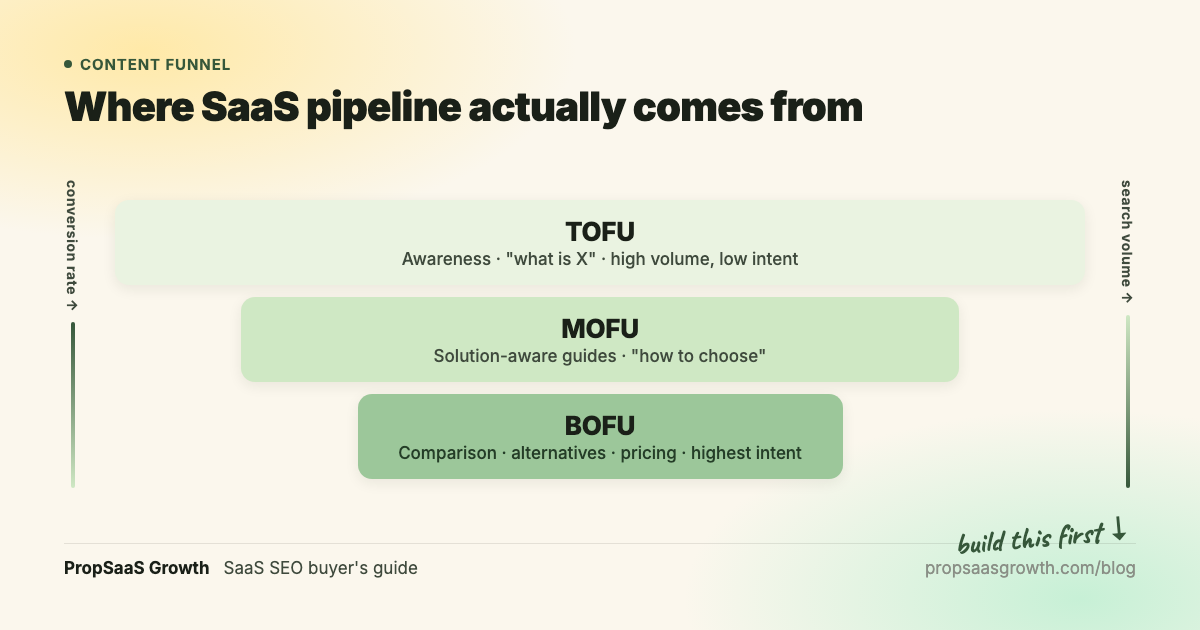
TOFU content includes "what is X" explainers, category definition posts, and industry trends content. It generates high volume, builds domain authority, and strengthens brand recall over time.
BOFU content includes comparison pages ("[Product] vs. [Competitor]"), alternative pages ("Best [Competitor] alternatives"), use-case pages ("SaaS SEO for PropTech"), pricing pages, and ROI calculators. It generates lower volume with significantly higher conversion rates, because it reaches buyers who are actively comparing vendors.
MOFU (middle-of-funnel) content bridges the gap: solution-aware guides ("how to choose a SaaS SEO agency"), integration directories, and vertical-specific guides.
SaaS companies that prioritize BOFU content (comparison pages, alternative pages, use-case landing pages) typically see pipeline impact within the first two quarters, because BOFU pages reach buyers in active evaluation.
BOFU requires deep product and competitive knowledge, which is why the best SaaS SEO agencies build the BOFU architecture first. Once BOFU pages are converting, TOFU content expands reach and feeds the pipeline. For more on how this connects to pipeline, see our piece on why traffic and pipeline decouple and our guide to comparison pages for B2B SaaS AEO.
When evaluating an agency, ask what their BOFU-to-TOFU ratio looks like in the first 90 days. Agencies that prioritize BOFU early are typically the ones producing pipeline results by month six.
Link Building for SaaS SEO: How Much Does It Matter?
Link building remains an important signal for SaaS SEO, particularly in competitive keyword categories, but its relative weight has shifted. Quality backlinks from relevant industry publications, integration partner pages, and vertical directories matter more than volume. For early-stage SaaS companies, foundational technical SEO and BOFU content typically generate more pipeline impact per dollar than aggressive link building.
What works for SaaS link building:
- Contextual links from SaaS review sites, partner pages, and vertical media
- Digital PR and data-driven content pieces (original research, benchmark reports) that earn links naturally and also support AEO citation
- Integration partner pages and co-marketing content with complementary products
What to avoid:
- Private blog networks (PBNs) and guest post farms: these are a red flag and can create algorithmic risk
- High-volume, low-relevance link acquisition that inflates domain authority without improving ranking on target queries
For PropTech and FinTech SaaS, the most valuable links come from property management publications, fintech media, industry association sites, and vertical community forums. These signals carry more weight in niche categories than general business media links.
Link building is a long-term compounding investment. Most early-stage SaaS companies should prioritize technical fixes and BOFU content first, then add dedicated link building at the growth and enterprise stages when the conversion infrastructure is already producing results.
Early-Stage vs. Enterprise SaaS: Matching Agency Scale to Your Stage
The right SaaS SEO agency for a Seed-stage startup looks fundamentally different from the right agency for a Series B enterprise. Early-stage companies need fast wins, low overhead, and senior strategy without large team bloat. Enterprise SaaS needs a coordinated program across multiple product lines, regions, and content teams.
Seed to Series A ($3,000 to $6,000/month): An agency that can operate with limited internal resources, produce both strategy and execution, and show impact in 90 days on a tight retainer. At this stage, you need senior practitioners doing the work directly.
Series A to B ($6,000 to $15,000/month): A growth partner who can scale content production, coordinate with in-house teams, and expand into adjacent keyword categories. AEO monitoring should be part of the engagement at this stage.
Series B+ ($15,000 to $25,000+/month): A full-service partner with specialized roles (technical SEO, content, link building, AEO). At this stage, multiple agency relationships or a large retainer with dedicated team members becomes common.
A common mistake: Early-stage companies hire large agencies expecting senior attention and receive junior account management. Boutique agencies with senior practitioners are typically a better fit for early and growth-stage SaaS, where every dollar of retainer needs to produce measurable movement. Pricing data from Discovered Labs (February 2026) confirms these ranges across the SaaS market.
The embedded model (where agency practitioners work inside your Slack, dashboards, and workflow) is increasingly available at boutique agencies. Ask whether the agency offers this structure if coordination speed matters to your team.
Agency vs. In-House SEO: A Decision Framework for SaaS Teams
The decision between a SaaS SEO agency and building an in-house team comes down to three variables: speed-to-execution, budget, and depth of SaaS-specific expertise. For most SaaS companies below Series B, an agency partner is faster and cheaper than staffing a capable in-house team. Above Series B, a hybrid model often delivers the best results.
In-house advantages:
- Deep product knowledge and direct sales team access
- Faster iteration on brand voice and messaging
- Full control over content calendar and priorities
Agency advantages:
- Diverse SaaS client perspective and pattern recognition
- Pre-built tooling, processes, and frameworks
- No recruiting cost, benefits overhead, or ramp time
- Faster time-to-execution (an agency can start producing in weeks)
The cost comparison: A senior in-house SEO manager costs $120,000 to $160,000/year in total compensation in most US markets, plus $10,000 to $30,000/year in tools (Ahrefs, Semrush, GA4 integrations, AI monitoring platforms). A growth-stage agency retainer runs $6,000 to $15,000/month. For SaaS companies below Series B, an agency retainer typically costs less than a single senior in-house hire when accounting for total compensation and tooling.
The hybrid model: For Series B+ companies, the strongest setup is often an in-house SEO manager coordinating an agency for execution, content production, and specialized AEO work. The in-house lead owns the relationship with product and sales teams. The agency delivers production velocity and cross-client expertise.
For vertical B2B SaaS (PropTech, FinTech), in-house teams rarely have the vertical domain knowledge to produce credible technical content quickly. Agency specialists with category expertise tend to produce ranking content faster in niche verticals. A third model, the embedded agency partner that functions inside your workflow like a senior in-house team, addresses both the expertise gap and the coordination overhead of traditional agency relationships.
Red Flags to Watch for When Hiring a SaaS SEO Agency
Several warning signs during an agency sales process reliably predict poor delivery: vague case studies, guaranteed ranking promises, junior account teams, and no mention of AI search visibility. Recognizing these early saves 12+ months of misallocated budget.
- Red flag 1: Guaranteed rankings. Google explicitly warns against agencies making ranking guarantees. Rankings are an outcome of sustained effort, competitive dynamics, and algorithm updates. Any agency guaranteeing specific positions is either misleading you or targeting trivially easy keywords.
- Red flag 2: No mention of AI search visibility. A SaaS SEO agency pitching in 2026 without addressing AEO, AI citation share, or AI Overview optimization is operating with an outdated model. The market has moved.
- Red flag 3: Vague or unattributed case studies. Legitimate agencies cite real clients (with permission), real metrics, and real timelines. "We grew a SaaS company's traffic 300%" with no client name, no timeline, and no pipeline data is a weak signal.
- Red flag 4: Junior-heavy team structure. Ask who will actually work on the account. If the senior strategist disappears after the sales call and a coordinator manages day-to-day execution, you are paying for expertise you will rarely receive.
- Red flag 5: Content volume as the primary metric. Agencies that lead with "we will publish 20 posts per month" are optimizing for output. Pipeline impact comes from the right content targeting the right queries, published in the right sequence.
- Red flag 6: No structured onboarding or ICP research. If the agency skips understanding your buyer vocabulary, every content brief will be off-target. The best agencies mine buyer signals from Reddit, G2, sales call transcripts, and support tickets to build content briefs from how buyers actually describe their problems.
How Long Does SaaS SEO Take to Show Results?
SaaS SEO results follow a predictable pattern: technical fixes and quick-win optimizations produce measurable ranking movement in 60 to 90 days. Content investments begin compounding at 4 to 6 months. Meaningful pipeline attribution typically emerges at 6 to 12 months for most B2B SaaS companies in competitive categories.
Here is the month-by-month breakdown:
- Month 1 to 2: Foundation. Technical audit and fixes, keyword architecture, initial BOFU page drafts. Early ranking signals on low-competition terms. A structured audit in this phase surfaces the fastest-moving technical wins before content production scales.
- Month 3 to 4: Early traction. BOFU pages published and indexed. Initial comparison pages ranking. First demo or trial attributions from organic may appear on lower-competition queries.
- Month 5 to 6: Compounding begins. Hub-and-spoke internal link equity accumulates. Featured snippet wins on long-tail queries. Content refreshes start to move existing pages up in rankings.
- Month 7 to 12: Competitive territory. Competitive keyword categories becoming winnable. AEO citations beginning to register in monitoring tools. Organic pipeline contribution visible in attribution models.
- Year 2+: Compounding content assets, domain authority growth, and AI citation presence create a defensible organic moat that gets harder for competitors to replicate over time.
The exact timeline depends on three variables: the starting technical health of the site, competitive intensity in your keyword categories, and how quickly BOFU content is published and indexed.
What We Found When We Ran This Framework on Ourselves
The guidance above is easy to write. Harder to prove. So here is what happened when we applied the same evaluation criteria to PropSaaS Growth's own AI search presence.
In May 2026, we ran our five-archetype buyer prompt set (the same framework we use in client Foundation Audits) against our own brand across Claude and Perplexity. The prompt set covers category-default queries, job-to-be-done queries, pain-point triggers, buyer-stage qualifiers, and direct brand searches. We expected weak results. We found zero presence across all five archetypes. No mentions. No citations. Complete invisibility. (For the full account, see I Ran My Own AEO Framework on My Own Brand. I Was Invisible.)
The agencies and individuals that were cited in our place included Discovered Labs, Austin Heaton, RevenueZen, Team 4, First Page Sage, and NoGood. Some had weaker domain authority than ours. All had published content structured for the specific queries AI engines decompose "best SaaS SEO agency" into.
That result shaped the framework we now recommend to clients evaluating SaaS SEO agencies:
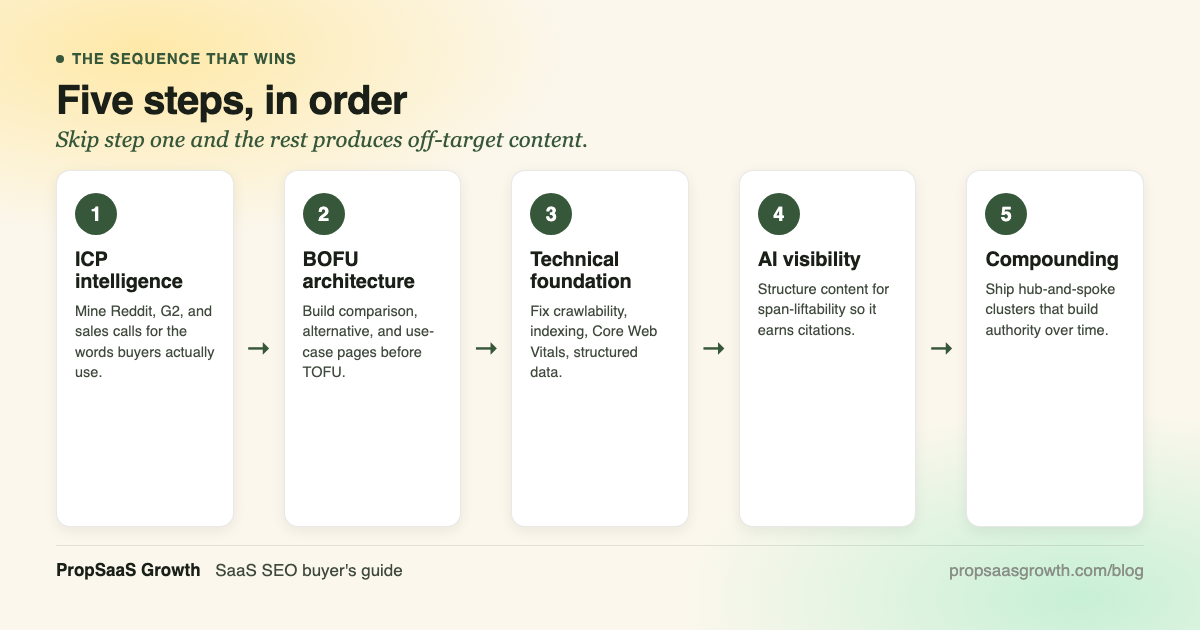
- Step 1: ICP Intelligence Layer. Extract buyer vocabulary from Reddit threads, G2 reviews, and sales call transcripts. This surfaces terms and pain-point framing that keyword tools systematically miss.
- Step 2: BOFU Architecture. Map the BOFU content set (comparison pages, alternative pages, use-case pages) before building TOFU. Conversion infrastructure first, traffic expansion second.
- Step 3: Technical Foundation. Audit and fix crawlability, indexing, Core Web Vitals, and structured data before scaling content.
- Step 4: AI Visibility Layer. Structure content for span-liftability (definition headers, Q&A format, self-contained claims) so it is eligible for AI citation alongside organic rankings.
- Step 5: Compounding Expansion. Publish hub-and-spoke content clusters that build topical authority over time.
Use this sequence to evaluate any SaaS SEO agency you are considering. The agencies that follow a version of it will outperform those that skip the ICP layer and jump straight to content production. We are running the same sequence on our own site right now, and we will publish the results as they develop.
Action Steps
The following six steps move you from awareness to a signed retainer with a SaaS SEO agency that fits your stage, vertical, and budget. Each step has a concrete output so you know when it is done.
- Define your stage and budget band. Use the pricing framework above to identify whether you are early-stage ($3K to $6K/month), growth-stage ($6K to $15K/month), or enterprise ($15K to $25K+/month). Output: a written budget range for your procurement conversation.
- Identify your vertical requirements. List the top 5 keyword categories that reflect your buyer's vocabulary in your specific vertical (PropTech, FinTech, B2B SaaS). Use this as a screening filter when agencies pitch. Output: a 5-keyword vertical filter list.
- Shortlist 3 to 5 agencies using the evaluation questions above. Prioritize agencies that can demonstrate BOFU content experience and AI citation tracking. Output: a shortlist with notes on each agency.
- Request case studies with pipeline metrics. Requesting pipeline attribution data (organic-to-demo or organic-to-trial) rather than traffic charts is the fastest way to distinguish SaaS SEO agencies that are serious about revenue from those optimizing for vanity metrics. Output: at least one verified case study per shortlisted agency.
- Run a Foundation Audit before committing to a full retainer. A structured audit surfaces the fastest-moving wins and gives you a concrete deliverable to evaluate the agency's thinking. PropSaaS Growth's Foundation Audit is available on our services page. Output: a prioritized roadmap you own regardless of who executes it.
- Set a 90-day review milestone. Agree on 3 measurable outcomes at 90 days (ranking movement, BOFU page indexing, first organic pipeline attributions). Output: a written 90-day success definition before signing.
Conclusion
The best SaaS SEO agency for your company is the one that understands your buyer's vocabulary, can build a BOFU content architecture, integrates AI search visibility alongside traditional organic rankings, and operates at the right scale for your stage.
With AI-generated B2B web traffic growing at 40%+ per month (Forrester via DigitalCommerce360, 2025), the agencies that will generate the most pipeline in 2026 and beyond are those that integrate traditional organic SEO with AI citation visibility from the start of the engagement.
The evaluation framework, pricing benchmarks, and red flags in this guide give you what you need to make this decision with confidence.
Frequently Asked Questions
What is a SaaS SEO agency?
A SaaS SEO agency specializes in organic growth for software companies, combining technical SEO, content strategy, and AI search visibility to generate qualified pipeline for SaaS products. The key difference from a general SEO agency is deep knowledge of SaaS buyer journeys, product-led growth mechanics, and recurring-revenue economics. Agencies in this category understand how MRR, CAC payback, and NRR shape every keyword and content decision.
How much does a SaaS SEO agency cost?
SaaS SEO agency retainers range from $3,000/month for early-stage companies to $25,000/month for enterprise programs (Discovered Labs, February 2026). Project-based engagements like a Foundation Audit typically run $5,000 to $15,000 depending on scope. The main cost drivers are competitive intensity in your keyword categories, content production volume, and whether AI citation monitoring is included.
What KPIs should I expect from a SaaS SEO agency?
Expect four tiers of KPIs: pipeline impact (demo requests and trial signups from organic), traffic quality (ICP-matched sessions, BOFU page conversion rates), search presence (keyword ranking distribution, featured snippet wins), and AI visibility (citation share in ChatGPT, Perplexity, and Google AI Overviews). Strong SaaS SEO agencies report on all four.
How long does SaaS SEO take to show results?
Initial ranking movement on low-competition terms typically appears within 60 to 90 days. Compounding content growth begins at 4 to 6 months. Pipeline attribution from organic becomes measurable at 6 to 12 months for most B2B SaaS companies in competitive categories. The exact timeline depends on the starting technical health of the site, competitive intensity, and how quickly BOFU content is published and indexed.
Should I hire a SaaS SEO agency or build in-house?
For companies below Series B, a specialized SaaS SEO agency reaches full execution faster and at lower total cost than building an in-house team. A senior in-house SEO hire costs $120,000 to $160,000/year in total compensation plus tools, compared to $6,000 to $15,000/month for a growth-stage agency retainer. Above Series B, a hybrid model (in-house SEO manager coordinating an agency) often delivers the best results.
What is the difference between SEO and AEO for SaaS?
SEO (Search Engine Optimization) focuses on ranking in traditional Google results. AEO (Answer Engine Optimization) focuses on earning citations in AI-generated answers from tools like ChatGPT, Perplexity, and Google AI Overviews. For B2B SaaS companies, both matter: generative AI has overtaken traditional search for a quarter of B2B buyers researching vendors (Responsive, 2025), and AI Overviews appear in roughly 15 to 25% of searches depending on the study (Semrush; Conductor, 2025). The best SaaS SEO agencies integrate both in a single program.

Gemma Smith, Founder, PropSaaS Growth
SEO, AEO, and content strategy for PropTech, FinTech, and B2B SaaS companies. 10+ years in PropTech. Active engagements with vertical SaaS platforms.