
"Landing page seo" gets 1,200 US searches a month at a keyword difficulty of 9, and "seo for landing pages" adds another 700 at a difficulty of 17 (Ahrefs, August 2026). Soft terms with real volume usually mean the existing answers are thin, and in this case they are thin in a specific way. Almost all of them were written for a page whose job is to be read.
Product pages, solution pages, and demo pages have a different job. They exist to produce a booked call. When you apply article advice to them, you get a page that reads like a blog post with a form stapled to the bottom, and it underperforms at both things.
This post is about the division of labor: what a conversion page should carry, what should live on supporting content, and how a conversion page earns retrieval without borrowing patterns that were built for articles.
Landing Page SEO Is Two Different Jobs
When someone says they want to improve landing page SEO, they usually mean one of two things, and the two pull in opposite directions.
The first is ranking and retrieval for the buying query. Someone types or asks a question that means they are ready to evaluate vendors. "Contract review software for legal teams." "Best tool for X." "Who does Y for Z." The page needs to be the answer to that specific question.
The second is capturing the informational traffic that surrounds the category. What the category is, how it works, how to choose, what it costs. That traffic is larger and earlier, and it is genuinely valuable, which is why so much advice tells you to build it into the product page.
The mistake is assigning both to the same URL. A page optimized for a buyer who is ready has a short path to the CTA, a narrow claim, and no detours. A page optimized for someone learning the category has definitions, context, and breadth. Merge them and you get a page where the buyer has to scroll past an explainer to reach the thing they came for, while the learner gets a page that keeps trying to sell them something.
My rule is that a conversion page is accountable to exactly one query. Everything else routes to spoke content in a hub-and-spoke structure, and the page links out to it.
The Advice That Backfires
Four patterns show up in nearly every landing page SEO checklist. All four are correct for articles. All four cause damage on a conversion page.
The direct-answer opening. On a blog post, opening with a compact definitional paragraph is one of the most reliable ways to get lifted into an AI answer. On a product page, it replaces your positioning with a category definition. The first thing a ready buyer reads becomes a description of the problem space they already understand, and the page has spent its most valuable real estate explaining something to the wrong person.
The educational FAQ. "What is contract lifecycle management?" is a question your buyer stopped asking before they arrived. Putting it in the FAQ signals to the reader that this page is for beginners, and it competes with your own spoke content for the same query. You end up with two pages of yours in the same consideration set, which is the self-competition problem in a different costume.
The keyword-led H1 rewrite. Replacing a positioning headline with an exact-match keyword string is the single most common way a landing page loses conversion rate for a ranking gain that does not arrive. The H1 on a conversion page has a job, which is to make a specific promise to a specific buyer. Exact-match phrasing is worth having in the page, and it does not have to be in the one line doing the most persuasive work.
Length for its own sake. Word count correlates with rankings across a corpus. It does not cause them on a single page, and on a conversion page every additional section is another scroll between the visitor and the form. I have never seen a product page improve by getting longer without also getting more specific.
The common thread is that each pattern optimizes for a reader who is not the reason the page exists.
What Makes a Conversion Page Retrievable
Conversion pages do get cited. The route is narrower than it is for articles, and it does not run through blog structure.
When I looked at what my own content actually earned in AI search, the pages that got cited were cited because they were the most literal available answer to one specific question. That finding holds for conversion pages too, and it defines the whole strategy. A product page will not win "how do I choose a contract review tool." It can win "what does a contract review tool do with a non-standard indemnity clause," because that question has a concrete answer and most vendor pages refuse to give one.
Three things make the difference.
Decision logic instead of outcome claims
Most product pages state outcomes. "Faster reviews." "Fewer escalations." "Save your team hours every week." These are unliftable. There is nothing in them an engine can quote as an answer, because they contain no reasoning, and every competitor says the same thing.
What is liftable is the logic underneath. Show what the product does across several different inputs, including at least one where it does nothing. A page that says "here is the case where this escalates to a human, here is the case where it resolves automatically, and here is what determines which" has said something specific enough to be worth quoting, and specific enough to be checkable. Vendor pages that show the boundaries of their own product are rare, which is exactly why they get retrieved.
Structure that isolates the answer
Decision logic buried in a paragraph of body copy is hard to lift. The same logic rendered as a set of parallel cases, each with a labeled input and a labeled outcome, is trivial to lift. Tables, definition lists, and repeated card structures with consistent internal labels all work, because they make it obvious where one answer ends and the next begins.
This is the part that most benefits both audiences at once. A scannable structure that lets a buyer find their own scenario in four seconds is the same structure that lets a retrieval system isolate a discrete answer.
Specificity as the unit of proof
Named platforms, named thresholds, named integrations, real numbers with the window they were measured over. "Integrates with your existing stack" is worth nothing on either front. A named list of five platforms is a retrievable fact and a purchase-blocking question answered in the same breath.
The same applies to proof. A statistic placed next to the claim it supports does more than the same statistic collected in a logo bar at the top of the page, because proximity is what makes it usable as evidence rather than decoration.
A Worked Example
Take a contract review platform selling to legal operations teams. The buying question is roughly "what happens when a contract comes in with terms we have not seen before."
The version that follows standard landing page SEO advice opens with "What is contract lifecycle management?", carries an FAQ explaining what a redline is, and states that the product "accelerates review cycles by up to 70%."
The version built for both jobs answers the actual question with structure:
| What arrives | What the system does | Where it lands |
|---|---|---|
| Standard MSA on your own paper, no edits | Clause-by-clause match against the approved template, no deviations found | Auto-approved, logged, counsel never sees it |
| Vendor paper with a modified liability cap | Flags the deviation, quotes the approved position beside it, drafts the fallback | Queued for counsel with the redline already written |
| Non-standard indemnity with an uncapped obligation | Matches nothing in the playbook, no fallback exists | Escalated immediately, no automated suggestion offered |
Three things happened in that table. The buyer got the answer to their real question in one glance. The page admitted a case where the product defers to a human, which is the detail that makes the other two rows credible. And an answer engine now has a discrete, attributable, checkable response to "what happens when a contract has a non-standard indemnity clause," which no competitor page contains because they are all still claiming 70% faster reviews.
The page never defined contract lifecycle management. That question goes to a spoke, and the page links to it.
The Division of Labor
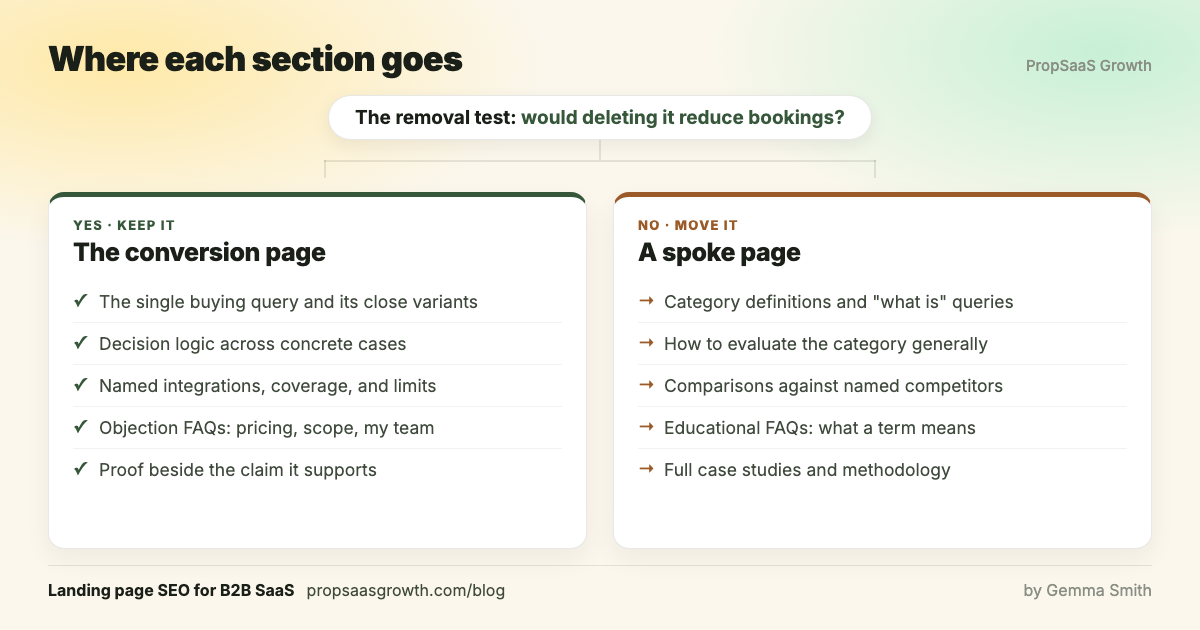
The full split I work to:
| Belongs on the conversion page | Belongs on a spoke |
|---|---|
| The single buying query and its close variants | Category definitions and "what is" queries |
| Decision logic across concrete cases | How to evaluate the category generally |
| Named integrations, coverage, and limits | Comparisons against named competitors |
| Objection-level FAQs: pricing model, scope, what happens to my team | Educational FAQs: what a term means, how the process works |
| Proof placed beside the claim it supports | Full case studies and methodology writeups |
Two clarifications on that table, because both get misread.
FAQs are not banned from conversion pages. Objection-level questions belong there, and they are some of the highest-value content on the page. "Does this replace my existing team," "is there a setup fee," "do you cover my region" are questions a buyer needs answered before booking. They also happen to be well-formed retrievable answers. The rule is about which questions, and the dividing line is whether a buyer would ask it after deciding they are interested.
Competitor comparisons are the other case people get wrong. They feel like bottom-of-funnel content and they belong on their own URLs, because a comparison page has its own structure and its own query set. Folding a comparison into a product page weakens both.
How to Test Your Own Page
Five steps, about an hour per page.
1. Name the single buying query. Write down, in one sentence, the question a buyer is asking at the moment they would land here. If you cannot name it, the page has no retrieval target and no conversion thesis. This is downstream of knowing precisely who the page is for, and pages that fail this step usually fail because they are addressing two buyer types at once.
2. Run the removal test on every section. For each section, ask whether deleting it would reduce bookings. Not whether it is interesting, and not whether it ranks. Whether fewer people would book. Sections that survive stay. Sections that fail become spoke content, and the page links to them.
3. Convert your top three claims into decision logic. Take the three biggest outcome claims on the page and rewrite each one as the reasoning that produces it, across at least two different inputs. If you cannot describe a case where your product defers, declines, or does nothing, you do not yet have the specificity that gets retrieved.
4. Rewrite the FAQ to objection level. Cut every question that defines a term. Replace them with the questions your sales team actually fields on first calls. If you want the source material for this, your own call recordings and your category's review sites both carry it in the buyer's own phrasing.
5. Track retrieval separately from rankings. Run your buying query and its close variants across the major answer engines on a fixed schedule and record whether the page is cited. A small fixed prompt set run consistently is worth more than a large one run once, and it is the only way to tell whether a page change moved anything. The measurement setup is straightforward and mostly a question of running it on a schedule.
The takeaway
Landing page SEO fails when it treats a conversion page as an article with a form on it. The page has one query to answer and one action to produce, and everything that does not serve those two things belongs somewhere else on the site, linked rather than absorbed.
The part worth internalizing is that this does not trade retrieval away for conversion. A page that states specific decision logic, shows the boundaries of its own product, and answers real objections is more retrievable than the same page with an explainer bolted onto the top, because it contains answers that nothing else in the category contains. Specificity is what serves the buyer and what gets quoted. The generic version loses twice.
Frequently asked questions
Should landing pages have FAQ sections for SEO?
Yes, with a restriction on which questions. Objection-level questions belong on a conversion page: pricing model, scope, coverage, what happens to existing staff or systems. Educational questions that define category terms belong on spoke content, because they address a reader who is not ready to buy and they compete with your own informational pages for the same query.
Can a product page rank for informational keywords?
Sometimes, and it is usually a bad trade. Ranking a conversion page for an informational query brings visitors who are not ready to act, which suppresses the page's conversion rate and tells you little about whether the page works. The stronger structure is a dedicated page for the informational query that links to the conversion page, so each URL is accountable to one intent.
How long should a B2B SaaS landing page be?
Long enough to answer the buying question and the objections that follow it, and no longer. Length itself does nothing. Specificity does. A 900-word page with named integrations, concrete decision logic, and real objection handling will outperform a 3,000-word page built out of category explanation and outcome claims.
Do AI answer engines cite product pages?
They do, for narrow questions that have concrete answers. A product page will rarely be cited for a broad evaluation question like how to choose a vendor in the category. It can be cited for a specific operational question about what the product does in a defined situation, because that question has one correct answer and the vendor is the authoritative source for it. Most vendor pages never get cited because they contain claims rather than answers.
Should I put my target keyword in the landing page H1?
Have the exact phrasing somewhere on the page, and let the H1 do its persuasive job. Rewriting a positioning headline into an exact-match keyword string is a common way to lose conversion rate for a ranking gain that often fails to arrive. Subheads, the intro paragraph, and the title tag all carry the phrasing without spending the one line doing the most work.
What is the difference between a landing page and a blog post for AEO?
The retrieval route differs. A blog post earns citations by being the most complete and most literal answer to a question, which rewards direct-answer openings and thorough coverage. A conversion page earns citations by containing specific, checkable facts about a product that exist nowhere else, which rewards decision logic, named specifics, and stated limits. Applying blog structure to a conversion page imports the pattern without the payoff.
How do I know whether a section belongs on the page or on a spoke?
Ask whether deleting the section would reduce bookings. If the honest answer is no, move it to spoke content and link to it from the page. This keeps the conversion path short while preserving the traffic value of the material, since the spoke page can rank and be cited on its own.
How often should landing pages be updated for AI search?
Change the page when the product changes or when tracking shows a retrieval gap, rather than on a calendar. The useful cadence is on measurement: run a fixed prompt set on a regular schedule, watch which questions the page is missing, and make targeted edits that add the specific answer the page lacks. Rewriting on a schedule without a measured reason tends to erode pages that were already working.

Gemma Smith, Founder, PropSaaS Growth
SEO, AEO, and content strategy for PropTech, FinTech, and B2B SaaS companies. 10+ years in PropTech. Active engagements with vertical SaaS platforms. AirOps Champion.