
In May I ran my own AEO framework on my own brand and published the starting position. This is the follow-up with a full quarter of data behind it. Every number here comes from my own property: Google Search Console for the search side, a fixed 49-prompt set run daily across five answer engines for the AI side, and Ahrefs for the link profile. Nothing is modeled, extrapolated, or borrowed from someone else's case study.
I am publishing the disappointing version because the flattering version is already everywhere, and because a consultancy that sells measurement should be willing to show its own numbers when they are unimpressive.
What I Actually Shipped
Between May 17 and August 3, 2026, I published 31 posts on this site. That is 78 days, or 11.1 weeks, at an average of 2.8 posts per week. The corpus runs to 110,683 words with an average post length of 3,570 words. Every post shipped with a full schema stack, a TL;DR block, a table of contents, an FAQ section, internal links, and a custom Open Graph image.
This is not a content mill. Each post was researched, sourced, and edited, and several were rewritten after publication when a source turned out to be misattributed. If output quality and structural completeness were the binding constraint, this program should have worked.
Two measurement windows matter for what follows. Search Console data covers 90 days, May 4 to August 1. AI citation tracking started later, on June 3, and covers through August 2, so roughly nine weeks. The AI numbers therefore describe a corpus that was already two thirds built when tracking began.
What Google Did With It
Ninety days of Search Console, compared against the previous ninety:
| Metric | May 4 to Aug 1 | Prior 90 days |
|---|---|---|
| Clicks | 25 | 0 |
| Impressions | 3,805 | 14 |
| CTR | 0.66% | 0.00% |
| Average position | 33.4 | 20.1 |
Twenty-five clicks. That is the honest number for 110,683 words.
Average position went from 20.1 to 33.4, which reads like a regression and is not one. The prior window had 14 impressions total, so its average position described almost nothing. As the site started ranking for hundreds of new terms, most of them deep on page three and four, the average moved toward where the bulk of the corpus actually sits. Publishing a lot of new pages on a young domain mechanically drags average position down. It is a composition effect, not a decline.
The distribution is more useful than the total. Of 25 clicks, 11 went to the homepage and 10 went to a single post about whether Google uses llms.txt, which sits at position 11.3 on 747 impressions. Twenty-one of 25 clicks came from two URLs. The remaining 29 posts produced four clicks between them.
The most instructive page is one that earned nothing. My AEO consultant landing page collected 812 impressions, the largest pool on the site, at an average position of 39.5, and converted them into zero clicks. Google is showing that page to people searching for exactly what I sell, on page four, where nobody looks. That is not a content problem. That is an authority problem, and no amount of additional publishing addresses it directly.
What the Answer Engines Did With It
The AI side runs on a fixed set of 49 category-level prompts, the kind a buyer would actually ask, run daily against ChatGPT, Gemini, Perplexity, Google AI Mode, and Google AI Overviews. Between June 3 and August 2 that produced 14,917 sampled answers.
Those 14,917 answers contained 13 citations of my domain. That is a citation in fewer than one in a thousand answers.
Here is where they landed:
| Page | Citations | Citing prompts |
|---|---|---|
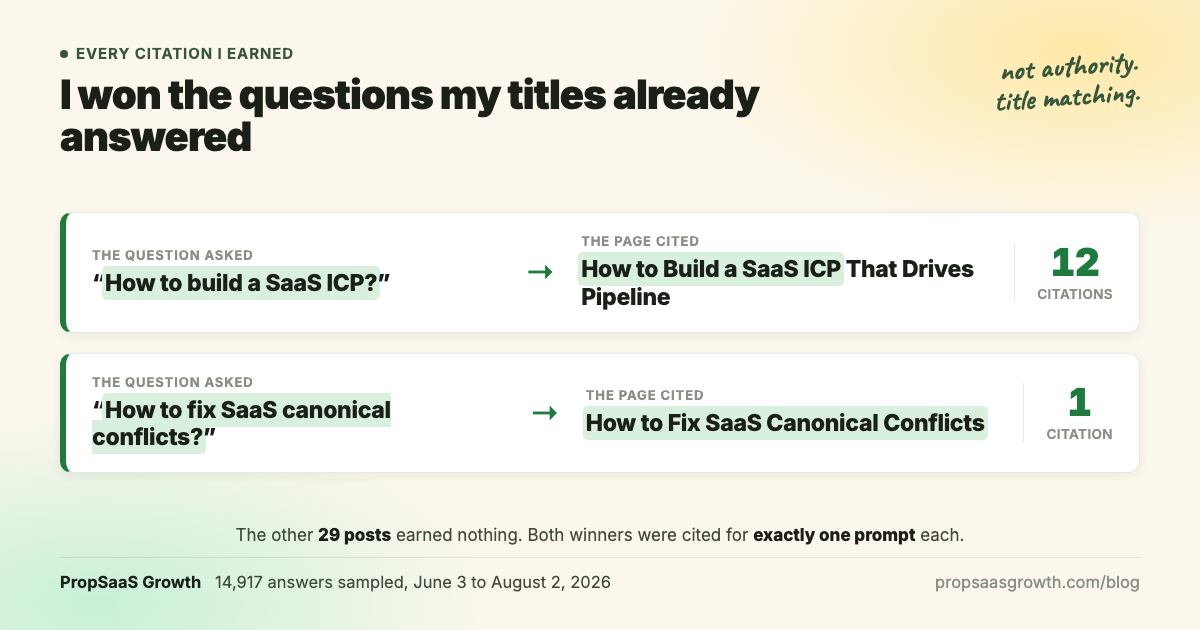
| How to Build a SaaS ICP That Drives Pipeline | 12 | 1 |
| How to Fix SaaS Canonical Conflicts | 1 | 1 |
| Every other tracked page (28) | 0 | 0 |
Two pages out of 30 tracked earned every citation the domain received. Twenty-eight earned none. Not few. None.
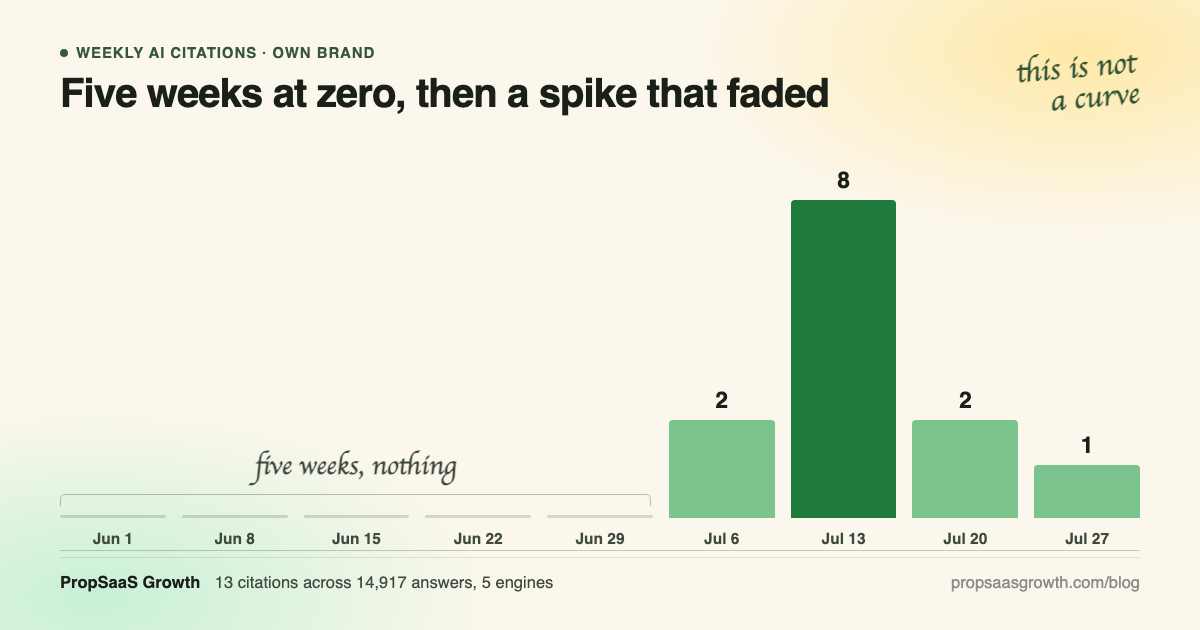
The shape over time is worth reporting too, because it is not the shape everyone draws on a slide. Five straight weeks of zero, then 2 citations in the week of July 6, 8 in the week of July 13, 2 in the week of July 20, and 1 in the week of July 27. It spiked and faded rather than climbing. Whatever produced that week of 8 did not persist, and I would be inventing a mechanism if I told you why.
Brand mentions, which are a softer signal than citations because they do not require a link, were similarly thin. Mention rate across the whole period ranged from 0.07% on ChatGPT to 0.47% on Gemini. Share of voice against my four tracked competitors ran between 1.61% and 4.56% depending on the engine. Those are non-zero, which is worth something on a domain this young, and they are nowhere near a level that produces inbound.
The Finding That Actually Matters
The concentration is interesting. The reason for it is the part that changed how I think about this work.
Both cited pages were cited for exactly one prompt each. Not a cluster of related questions. One.
The post titled "How to Build a SaaS ICP That Drives Pipeline" earned all 12 of its citations from the prompt "How to build a SaaS ICP?". The post titled "How to Fix SaaS Canonical Conflicts" earned its single citation from the prompt "How to fix SaaS canonical conflicts?".
In both cases the question is a near-verbatim restatement of the page title. That is not topical authority. That is title matching on a narrow, literal question, and it is a substantially weaker result than it first appears.
The distinction matters because the two things behave differently. Topical authority means an engine reaches for you across a range of questions in your domain, including ones you never wrote a page for. Title matching means an engine found the one page on the internet whose headline restated the question and used it. The first compounds. The second is a lottery ticket you buy once per page, and it pays out only when someone asks your exact question with your exact framing.
I have written before about how SaaS brands earn AI citations, and that post argues for answer-first, entity-forward passages engines can lift. My own data does not contradict that, but it adds a blunter prior condition: at low authority, the only questions you win are the ones where you are the most literal available answer. The sophisticated passage-level work matters later. First you have to be findable at all.
The uncomfortable implication is that 29 of my posts are competing for questions where a more authoritative page already exists, and no amount of structural polish on my version changes the outcome.
Every Citation Came From Google
The engine split is stark:
| Engine | Answers sampled | Citations | Mention rate |
|---|---|---|---|
| Google AI Mode | 2,989 | 10 | 0.23% |
| Google AI Overviews | 2,964 | 3 | 0.17% |
| ChatGPT | 2,988 | 0 | 0.07% |
| Gemini | 2,989 | 0 | 0.47% |
| Perplexity | 2,987 | 0 | 0.17% |
All 13 citations came from Google's two AI surfaces. ChatGPT, Gemini, and Perplexity produced zero citations each on roughly 3,000 answers apiece.
The most plausible reading is that Google's AI surfaces are drawing on the conventional index, where a young domain with clean technical foundations can at least be seen, while the standalone assistants lean harder on established, high-authority sources and never surfaced my pages at all. Gemini is the interesting outlier: it had the highest mention rate of any engine at 0.47% and still never cited a URL. It knew the brand existed and never sent anyone to it.
This has a practical consequence I did not expect. When I wrote about ChatGPT driving 92% of AI referral traffic, the honest caveat in that post was that the underlying study excluded Google AI Overviews. My own data lands on the other side of that caveat. For a young domain, the Google surfaces are where the first citations appear, and optimizing exclusively for ChatGPT would have produced nothing at all in this window.
Who Is Winning the Citations I Am Not
Counting my own citations tells me I lost. Counting everyone else's tells me what I lost to, and that turned out to be the more useful number.
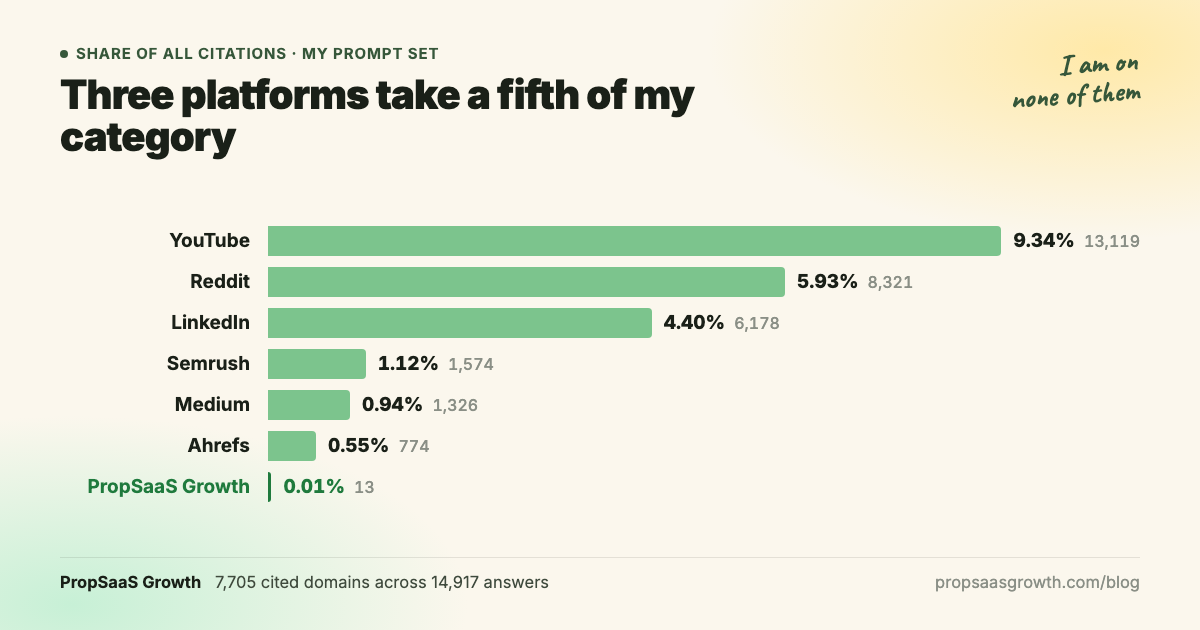
Across the same 14,917 answers, 7,705 distinct domains were cited. Here is the head of that list:
| Domain | Citations | Share | Unique URLs cited |
|---|---|---|---|
| YouTube | 13,119 | 9.34% | 818 |
| 8,321 | 5.93% | 773 | |
| 6,178 | 4.40% | 704 | |
| Semrush | 1,574 | 1.12% | 87 |
| Medium | 1,326 | 0.94% | 261 |
| Ahrefs | 774 | 0.55% | 24 |
| PropSaaS Growth | 13 | — | 2 |
Three platforms take roughly a fifth of every citation in my category. Not publishers, not agencies, not vendors. YouTube, Reddit, and LinkedIn. I have no presence on any of the three, and I have spent eleven weeks publishing exclusively on a domain I own.
This is my own argument used against me. In the piece I wrote on earning AI citations I cited Muck Rack's finding that roughly 84% of cited sources were earned media, and then built a program that was 100% owned. The prompt set I run on myself has been telling me that for two months and I was reading the wrong column.
The competitor comparison points the same direction, with one detail I did not expect:
| Brand | Mention rate | Average position when mentioned |
|---|---|---|
| Grow & Convert | 5.55% | 1.41 |
| Animalz | 2.68% | 1.08 |
| Refine Labs | 1.43% | 1.67 |
| Foundation Inc | 1.19% | 1.10 |
| PropSaaS Growth | 0.22% | 2.00 |
Grow & Convert is named about 25 times more often than I am. But look at the second column. When an engine does reach for me, it puts me second, which is within touching distance of brands that have been at this for years. That reframes the problem usefully. I do not have a positioning problem or a credibility problem. I have a frequency problem. The engines are not choosing me over someone else and getting it wrong. They are simply not reaching for me at all.
The 355 Backlinks I Never Asked For
One number in the Ahrefs profile looks great in isolation: 495 live backlinks from 355 referring domains. For a domain this young that would be a strong link profile.
The Domain Rating is 0.
The reason is visible the moment you sort the referring domains. The highest-rated ones are rankyour.website at DR 74, buybacklinks.agency at DR 70, backlinker.shop at DR 66, and pbnseolinks.shop at DR 53. Every single referring domain in the top 25 has zero organic traffic. The profile is close to 100% automated link-farm and PBN spam, all nofollow, and I never bought, requested, or exchanged a single link.
This is apparently just what happens to a new SEO-adjacent domain now. The link vendors find you, point their networks at you to make their own inventory look active, and Ahrefs correctly discounts the entire thing to nothing. I disavowed 168 domains on June 18 as precautionary hygiene, and I want to be clear that it was hygiene rather than a fix. The links are nofollow and already discounted. The disavow file changed nothing measurable.
The lesson is narrow and worth stating plainly: referring domain count is meaningless without looking at what the domains are. If I reported "355 referring domains" in a client update without the DR 0 next to it, that would be a lie told with a true number.
What This Changes About How I Work
Four things, in order of how much they changed my behavior.
Volume stops being the lever. At 2.8 posts a week for 11 weeks I have demonstrated that I can produce, and the production did not buy visibility. Post 32 competing for a question where a DR 80 domain already has the definitive page is worth less than a rewrite of a page sitting at position 12. I have two of those, and they are now ahead of any new post in the queue.
Pick questions by how literal you can be. The title-matching finding is exploitable. If citations at low authority go to the page that most exactly restates the question, then the selection criterion for new posts is not search volume. It is whether I can write the most precise, most literal answer to a question a buyer actually asks, phrased the way they phrase it. That is a narrower and less glamorous filter than a keyword list, and it is the one my data supports.
Measure citations per prompt, not per site. A site-level count of 13 would have told me almost nothing. The finding lives entirely in the breakdown to page and prompt, which is where the concentration and the title matching became visible. Any AI visibility report that stops at a total is hiding its own most useful information. This is the same argument I made in how to measure AI visibility, and running it on myself made it concrete.
Authority work is now the constraint. The 812-impression landing page stuck at position 39.5 is the clearest statement of the problem on the whole site. Google knows what that page is about and does not trust the domain enough to rank it. That is fixed with earned coverage and genuine third-party citation, not with more posts, and I had been treating it as a content problem for longer than I should have.
Owned-only was the wrong shape. The cited-domain data settles an argument I had been having with myself. If YouTube, Reddit, and LinkedIn take a fifth of the citations in my category, then a program that publishes exclusively to a domain I control is structurally capped no matter how good the pages are. I wrote a post about Reddit as an AEO surface and then did not post on Reddit. That gap between what I advise and what I run is the most embarrassing thing in this data, and it is the easiest to fix.
What This Does Not Prove
The result is one domain, one vertical, one quarter, and it would be easy to over-read.
The sample is small in the way that matters. Thirteen citations is few enough that a handful of answers moves any rate I could compute, which is why I have reported raw counts throughout rather than percentages that would imply more precision than exists. The month-over-month movement was similarly noisy: June produced mentions and no citations, July produced citations and no mentions. I do not think that pattern means anything, and I am not going to build a theory on it.
The window is also short and starts from zero. A domain with no history has to clear a discovery threshold before any of this compounds, and eleven weeks may simply be inside that threshold. The 60 to 90 day first-citation window I have cited before is consistent with what happened here: first citations landed about five weeks into tracking, on a corpus that was already two months old. The honest reading is that the mechanism works and the volume is negligible, which is a different claim from "this does not work."
And my prompt set is my own, which is the limitation I understated when I first published this. Forty-nine prompts chosen by me, weighted toward what I thought my buyers ask. After publishing I went back and audited the set itself, and it is worse than a generic caveat implies.
Forty of the 49 prompts are flagged very-low volume. Only three are high volume. Five pairs are effectively duplicates of each other, which quietly wasted about a tenth of the measurement budget on the same questions asked twice. So a meaningful part of "we are invisible" is that I was measuring visibility on questions almost nobody asks.
The three genuinely high-volume prompts make the point sharper. They are "What is the best SaaS SEO agency," "What is the best SaaS content strategy," and "Best way to analyze G2 reviews." I wrote a dedicated post for each one. All three return zero citations, and two of the three return zero mentions. Meanwhile the prompt that produced 12 of my 13 citations, "How to build a SaaS ICP?", is very-low volume.
Read together with the title-matching finding, that is a more specific and less comfortable conclusion than the one I started with. I won the low-volume questions where I was the most literal answer available, and lost every high-volume question outright. A better-constructed prompt set would not have produced better results. It would have produced worse ones, measured against questions that actually matter.
The takeaway
Eleven weeks, 110,683 words, 25 Google clicks, 13 AI citations, and 28 of 30 tracked pages with nothing at all. The library did not lift the pages. Two pages won two questions by being the most literal available answer, and the other 29 posts have so far bought exactly nothing measurable.
If you are running a content program on a young domain and your numbers look like this, they are probably normal, and the useful response is to stop measuring your program by what you shipped. Count citations per prompt, find the pages already within reach, and be honest about whether the constraint is content or authority. Mine was authority, and I spent eleven weeks writing as though it were content.
Three checks are worth running before you write another post. Audit your prompt set for volume and duplicates, because a program that looks invisible may be measuring the wrong questions. Look at which domains are being cited for your category, because if platforms dominate the head then owned content alone has a ceiling you cannot write your way past. And separate your mention rate from your position when mentioned, because being named rarely and being named badly are different problems with different fixes.
I will publish this again at six months with the same method, whether or not the numbers improve.
Frequently asked questions
How long does it take to earn AI citations for a new domain?
On my own brand the first citations landed in the week of July 6, about five weeks after tracking started, on a domain that was already publishing several posts a week. That is inside the 60 to 90 day first-citation window I have written about before, but the volume was tiny: 13 citations across 14,917 sampled answers in two months. It also did not behave like a curve. Citations peaked at 8 in the week of July 13 and fell to 1 by the week of July 27. Treat a first citation as a signal that the mechanism works, not as the start of a trend.
Does publishing more content improve AI visibility?
Not on its own, and my numbers are a clean example. I published 31 posts and 110,683 words in 11 weeks. Two of the 30 tracked pages earned a citation and 28 earned none. The posts that won did not win because the library around them got bigger. They won because they matched a specific question precisely.
Which AI engines cited a new B2B SaaS site first?
In my data, only Google's. Across two months, Google AI Mode produced 10 citations and Google AI Overviews produced 3. ChatGPT, Gemini, and Perplexity produced zero each, despite roughly 3,000 sampled answers apiece. Google's AI surfaces appear to lean on conventional index signals that a young domain can reach, while the standalone assistants did not surface the site at all.
Why did one post earn 12 of 13 citations?
Because its title was a near-verbatim match for the question being asked. The post is titled "How to Build a SaaS ICP That Drives Pipeline" and every one of its 12 citations came from the single prompt "How to build a SaaS ICP?". The same pattern held for the only other cited page. That is title matching on a narrow question, and it is a much weaker result than topical authority.
Is 355 referring domains a good backlink profile?
Not if they look like mine. My domain has 495 live backlinks from 355 referring domains and a Domain Rating of 0. The profile is almost entirely automated link-farm and PBN spam, every referring domain has zero organic traffic, and the links are nofollow. I never bought or requested a single one. Referring domain count is meaningless without looking at what the domains actually are.
Which domains get cited most in AI answers?
In my category, platforms rather than publishers. Across 14,917 answers and 7,705 distinct cited domains, YouTube took 9.34% of citations, Reddit 5.93%, and LinkedIn 4.40%, so roughly a fifth of every citation went to three platforms I have no presence on. Semrush, Medium, and Ahrefs followed well behind. If that pattern holds in your category, a content program published only to a domain you own has a structural ceiling regardless of page quality.
Should I stop publishing if the numbers look like this?
No, but you should stop treating volume as the lever. The useful move is to shift effort from net-new posts toward the small number of pages that are already close, and toward questions where your page can be the most precise answer available. On my site that meant two rewrites were worth more than the next five posts.

Gemma Smith, Founder, PropSaaS Growth
SEO, AEO, and content strategy for PropTech, FinTech, and B2B SaaS companies. 10+ years in PropTech. Active engagements with vertical SaaS platforms. AirOps Champion.